

Aged Garlic Extract Supplement: Why Aged Beats Fresh
The chemistry of fermentation turns raw garlic into something categorically different. Here is what 20 months actually does at the molecular level.
The word "aged" in aged garlic extract is not a marketing term for old garlic. It describes a specific fermentation process that chemically transforms the unstable, irritating compounds in raw garlic into stable, odorless, water-soluble molecules with superior absorption and a distinct clinical record. Understanding this transformation is essential to understanding why aged garlic extract and raw garlic supplements are not interchangeable.
What Happens Inside Fresh Garlic
Fresh garlic contains two key sulfur-containing compounds in separate cellular compartments: alliin, stored in the cytoplasm of garlic cells, and alliinase, an enzyme stored in vacuoles. When a garlic clove is crushed or chopped, the cell structure ruptures and alliinase contacts alliin. The enzymatic reaction converts alliin into allicin within seconds of cell damage.
Allicin is the source of the characteristic garlic smell. It is also the source of much of garlic's antimicrobial activity in laboratory settings. The problem is that allicin is chemically reactive and unstable. At body temperature and in the presence of stomach acid, it breaks down rapidly into diallyl disulfide, diallyl trisulfide, and other degradation products. These compounds are less bioavailable than the original allicin and contribute to the persistent garlic odor that appears in breath and through skin.
In raw garlic capsules, this same chemistry applies. Whether the capsule contains dried garlic powder, garlic oil, or an enteric-coated preparation, the allicin-based compounds face the same instability problem in the gastrointestinal environment. The compounds that reach plasma after raw garlic ingestion are primarily allicin degradation products at low concentrations, not a stable therapeutic compound.
Allicin: reactive, unstable, smelly, degrades in stomach acid. SAC and SAMC: stable, odorless, water-soluble, survive gastric transit, appear in plasma at measurable concentrations. The fermentation process converts the first into the second. This is not a minor refinement. It is a categorical transformation.
The Fermentation Process: 20 Months of Chemistry
The production of aged garlic extract begins with fresh garlic cloves submerged in a mixture of water and ethanol. The precise ratio and temperature are controlled throughout the aging period. The water-ethanol environment initiates a series of chemical transformations that occur gradually over 20 months.
In the first weeks of fermentation, allicin and its precursors begin converting. Allicin is unstable in the aqueous environment and transforms into various intermediate compounds. Over months, these intermediates undergo further transformations. By the end of the 20-month period, the dominant stable organosulfur compounds are S-allylcysteine (SAC) and S-allylmercaptocysteine (SAMC).
SAC is a water-soluble amino acid derivative. Its structure allows it to resist degradation in the gastrointestinal tract, absorb effectively in the small intestine, and appear in plasma at concentrations that correlate with the administered dose. SAMC is a related compound with similar stability and absorption characteristics. Both have been identified as the primary bioactive compounds responsible for the cardiovascular and antioxidant effects documented in aged garlic extract clinical trials.
The 20-month duration is not arbitrary. SAC concentration in aging garlic extract increases with fermentation time, accelerating in the later months. Studies measuring SAC content at 6, 12, 18, and 20 months show that maximum concentrations are reached around the 20-month mark. A shorter fermentation period produces a product with lower SAC content and reduced clinical potency, even at the same total milligram weight.
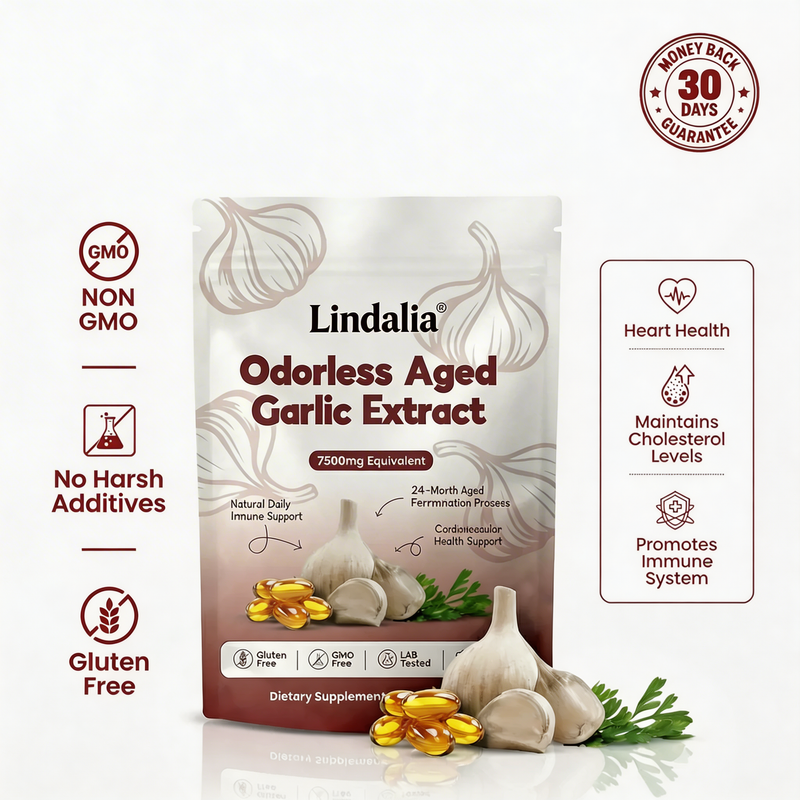
Not Just Aged. Fermented the Full Duration.
The complete 20-month fermentation produces the highest SAC concentrations. Clinical-range dose in one softgel.
See the ProductComparative Studies: Aged Garlic vs Raw Garlic on Antioxidant Activity
Head-to-head studies comparing aged garlic extract and raw garlic on antioxidant markers show consistent results in favor of the aged extract. The mechanism is the higher bioavailability of SAC and SAMC compared to allicin degradation products.
One well-cited comparison measured plasma antioxidant capacity after equivalent doses of aged garlic extract and raw garlic powder. Aged garlic extract produced significantly higher plasma antioxidant activity at 2-hour and 4-hour post-dose measurements. The raw garlic group showed lower and more variable antioxidant responses, consistent with the instability of allicin-based compounds in the gastrointestinal environment.
On LDL oxidation specifically, aged garlic extract demonstrates a more consistent reduction in ex vivo LDL oxidation susceptibility than raw garlic at equivalent doses. This is particularly relevant for cardiovascular risk, because oxidized LDL is the form that contributes to atherosclerotic plaque formation. SAC's antioxidant activity in plasma specifically reduces the oxidation of LDL particles, a mechanism that standard garlic products cannot replicate at typical doses due to their poor bioavailability.
Why Raw Garlic's Allicin Advantage Disappears After Ingestion
Raw garlic advocates often point to allicin yield as the key quality measure: more allicin means more potent garlic. This argument holds in a test tube but not in a human body. The instability of allicin in the gastrointestinal environment is well-documented.
Studies using radiolabeled allicin have confirmed that only a small fraction of ingested allicin survives gastric transit in its original form. Most converts to degradation products before reaching the small intestine. The degradation products have some antioxidant activity, but their plasma concentrations are inconsistent and substantially lower than what is achieved from the pre-formed SAC in aged garlic extract.
Enteric-coated raw garlic capsules delay this degradation by bypassing stomach acid. They deliver allicin to the intestine rather than the stomach. This improves the situation marginally, but allicin still undergoes rapid conversion in the intestinal environment. The odor reduction achieved by enteric coating is real (the stomach acid reaction that creates garlic breath is delayed), but the absorption improvement is modest compared to the inherent bioavailability advantage of SAC in aged garlic extract.
One persistent issue with raw garlic supplementation, even enteric-coated, is odor through the skin. This occurs because garlic-derived volatile sulfur compounds are absorbed into the bloodstream and excreted through sweat glands. Aged garlic extract does not produce this effect because the volatile compounds have been converted to non-volatile SAC and SAMC during fermentation.
Aging garlic for 20 months is not a process that weakens it. It is a process that makes its active compounds available to the body for the first time.
Cardiovascular Mechanisms Unique to Aged Garlic Extract
The cardiovascular benefits of aged garlic extract go beyond general antioxidant activity. SAC and SAMC act through several specific mechanisms documented in cell culture and clinical research.
Nitric oxide synthesis: SAC increases the activity of endothelial nitric oxide synthase (eNOS), the enzyme that produces nitric oxide in blood vessel walls. Nitric oxide is a potent vasodilator that reduces peripheral vascular resistance and lowers blood pressure. This mechanism is one reason the blood pressure effects of aged garlic extract are reproducible across clinical trials.
Platelet activity modulation: SAMC reduces platelet aggregation by inhibiting thromboxane synthesis. This antiplatelet effect is mild compared to pharmaceutical antiplatelet agents but is clinically meaningful over the long term. It contributes to reduced clotting tendency and is part of why practitioners flag this for patients on anticoagulants.
Arterial stiffness reduction: Clinical trials measuring pulse wave velocity, a marker of arterial stiffness, show that aged garlic extract reduces arterial stiffness over 12 to 24 weeks. Arterial stiffness is an independent predictor of cardiovascular events, and its reduction is a meaningful endpoint beyond blood pressure alone.
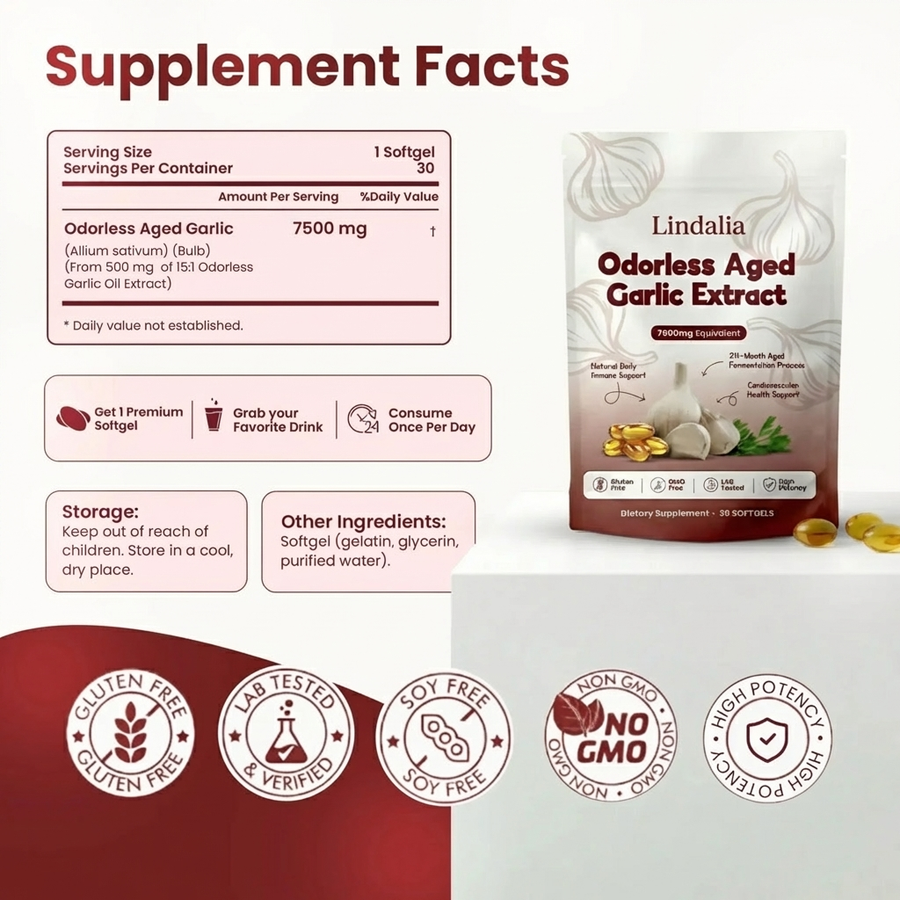
SAC and SAMC. Not Allicin.
20-month fermented. The stable compounds. The form that reaches plasma at measurable concentrations. Clinical-range dose.
See the ProductAged Garlic Extract and Black Garlic: A Brief Comparison
Black garlic, produced by heating garlic at high temperatures for weeks, is sometimes confused with or compared to aged garlic extract. The two are produced by different processes and produce different compound profiles. Black garlic contains higher concentrations of melanoidins (antioxidant compounds from the Maillard reaction) but lower SAC concentrations than 20-month aged garlic extract. It also lacks the specific clinical research base that aged garlic extract has accumulated.
Black garlic is a food product with antioxidant properties. Aged garlic extract is a supplement with documented cardiovascular and immune effects at specific doses. They are not equivalent, and black garlic supplementation does not replicate the clinical record of aged garlic extract.
The Dosing Implication of Better Bioavailability
Because SAC from aged garlic extract is water-soluble and survives gastric transit, the relationship between dose and plasma concentration is predictable and consistent. Clinical trials can define a dose-response relationship. At 7,500mg of aged garlic extract per day, plasma SAC reaches concentrations in the range documented to produce cardiovascular effects. At 500mg of raw garlic per day, plasma SAC concentrations are too low and too variable to produce consistent clinical outcomes.
This predictability is what makes aged garlic extract suitable for clinical use. It is also what distinguishes it from the general category of "garlic supplements," which includes products that cannot make any such claim about plasma concentrations or dose-response relationships.
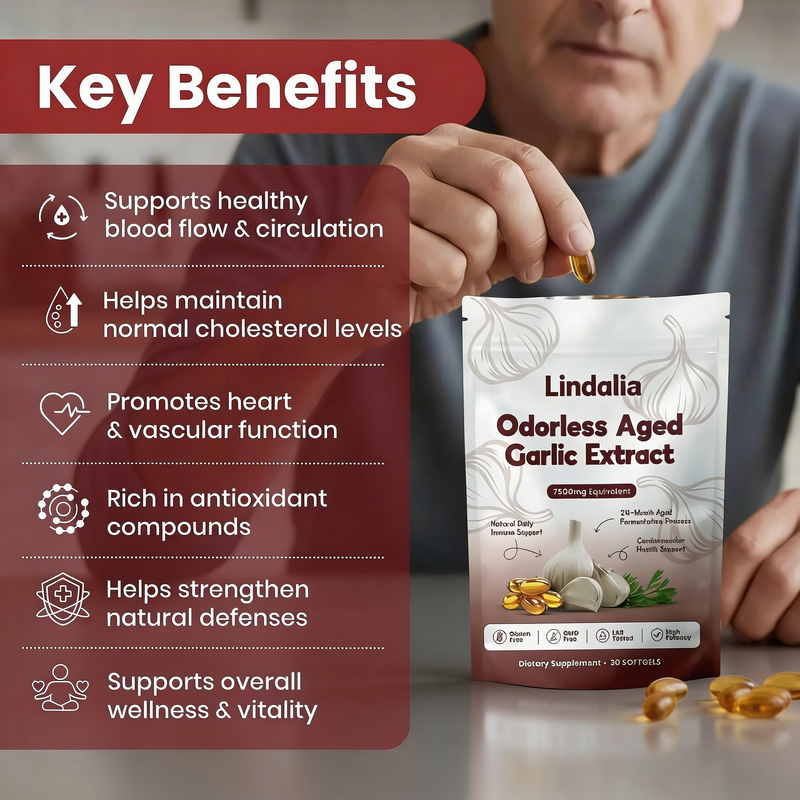
7500mg. One Softgel. Measurable Plasma SAC.
The dose that reaches plasma. The compound that survives digestion. Aged garlic extract, fermented 20 months.
See the Product