

Benefits of Oil of Oregano Capsules: The Full Breakdown
System by system, here is what the research says oil of oregano capsules actually do, along with the honest limits of the current evidence.
The benefits of oil of oregano capsules are not spread evenly across body systems. Some applications have strong mechanistic and clinical support. Others are supported by in vitro data that is promising but has not yet been fully translated to human clinical evidence. Understanding which benefits are well-established and which are still emerging is essential for using oregano oil capsules with accurate expectations and for the right reasons.
The Immune System: The Strongest Evidence Base
The immune system benefits of oil of oregano capsules are the most extensively documented. Carvacrol has demonstrated antimicrobial activity against a broad spectrum of pathogens that commonly cause respiratory and systemic infections. The mechanism, physical disruption of microbial cell membranes, is well-characterized at the molecular level and does not rely on biochemical specificity that could be overcome by pathogen mutation.
In vitro studies have shown carvacrol efficacy against common respiratory pathogens including Streptococcus pneumoniae, Haemophilus influenzae, and Staphylococcus aureus. Animal studies support the in vitro findings for several of these organisms. Human clinical studies specifically on oregano oil for immune support are more limited, but the mechanistic evidence and observational user data are consistent with a genuine immune support benefit.
The practical application: oregano oil capsules used during high-exposure periods (cold season, travel, periods of stress) maintain an elevated antimicrobial baseline. They do not prevent all infections but reduce the probability that exposure to a pathogen leads to established infection. This is the immune benefit most supported by the totality of the evidence.
In vitro evidence (laboratory cell studies) establishes mechanism but does not confirm human efficacy at supplement doses. Animal in vivo evidence is stronger but has translation gaps. Human clinical trials are the gold standard. For immune applications, oregano oil has strong in vitro and animal evidence and consistent observational human data, but limited randomized controlled trial evidence in humans specifically.
The Digestive System: Gut Dysbiosis and Candida
Gut health applications represent the second strongest evidence category for oregano oil capsules. The antimicrobial and antifungal activity of carvacrol against gut-resident opportunistic organisms is directly relevant to the most common gut health complaints: chronic bloating, gas, irregular bowel habits, and suspected candida overgrowth.
The softgel format delivers a particularly relevant advantage here. By releasing carvacrol in the small intestine rather than the stomach, softgels concentrate the active compound at the anatomical site where gut dysbiosis most commonly occurs. This intestinal-level delivery is mechanistically superior to gastric delivery for gut health applications.
For bacterial overgrowth (SIBO or generalized dysbiosis), the typical improvement timeline is one to two weeks for initial symptom reduction and four to six weeks for more complete microbiome rebalancing. For Candida-related gut symptoms, the timeline extends to two to four weeks for measurable antifungal effects, with some cases requiring two consecutive cycles to achieve full resolution.
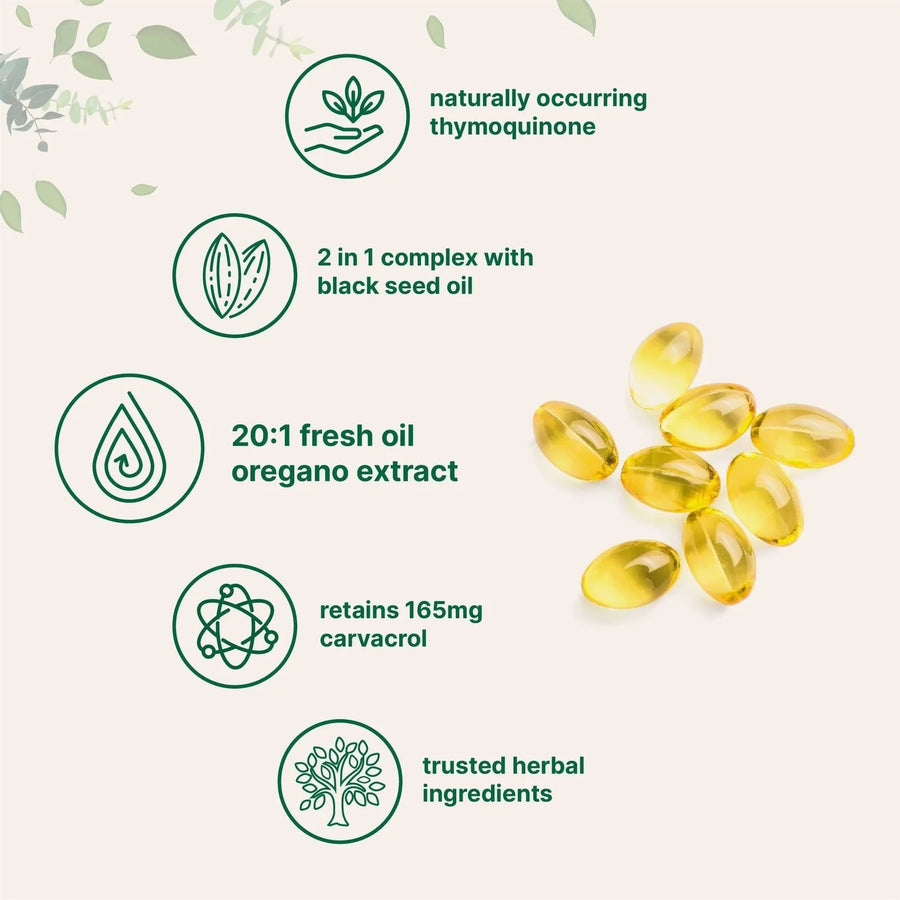
Oil of Oregano Softgels
Intestinal-release softgel: carvacrol delivered where your gut health needs it most.
See the ProductThe Respiratory System: Support During Infections
Respiratory system benefits include both antimicrobial activity against respiratory pathogens and mucolytic or expectorant effects that support mucus clearance during infection. Carvacrol has demonstrated activity in respiratory tissue studies against Streptococcus and Staphylococcus species, which are commonly involved in secondary bacterial infections following viral respiratory illness.
The mucolytic effect (thinning of respiratory mucus) has been documented in animal respiratory tissue models. Thinner mucus is more easily cleared from the airways, which reduces the stagnant mucus environment that promotes bacterial colonization and secondary infections. This is a supportive benefit rather than a primary antimicrobial one.
Honest limit: oregano oil capsules are supportive care for mild respiratory infections, not a treatment for serious lower respiratory tract infections (pneumonia, bronchitis with confirmed bacterial cause). Using oregano oil as the sole intervention for a serious respiratory infection in place of prescribed antibiotic treatment is not supported by the evidence and could be harmful.
The respiratory benefits of oregano oil are real and documented. They are adjunctive support for mild infections, not replacements for medical evaluation of serious respiratory illness.
The Skin: Antifungal Applications
The antifungal activity of carvacrol that is relevant for intestinal candida is the same mechanism relevant to fungal skin conditions. Fungal skin infections, including tinea (ringworm, athlete foot, jock itch) and skin candidiasis, involve fungal species whose cell membranes are susceptible to carvacrol.
Oral oregano oil capsule use for skin fungal conditions works through systemic distribution of carvacrol after intestinal absorption. The compound distributes through the bloodstream and reaches skin tissue at concentrations that may contribute to reduction of dermal fungal populations. This is a less direct application than topical antifungal treatment and typically takes longer to show effects (several weeks of consistent intake).
The evidence base for oral oregano oil specifically for skin fungal conditions is more observational than clinical. The mechanism is plausible and the antifungal chemistry is well-established. But controlled clinical trials specifically examining oral oregano oil for skin fungal conditions are limited. This is an area where user reports are positive and the mechanism is sound, but the clinical evidence base is thinner than for gut health applications.
For external fungal skin infections, topical application of diluted oregano oil (diluted in a carrier oil at 1 to 2% concentration) may provide more direct antifungal contact than oral capsules alone. Oral capsules contribute systemic antifungal support. Combining both approaches is a reasonable protocol for persistent external fungal skin conditions, but dilution is essential: undiluted essential oil on skin causes irritation.
Oil of Oregano Softgels
Wild-harvested carvacrol across all five benefit systems. Sealed softgel delivery, 1,900+ verified reviews.
See the ProductAnti-Inflammatory Effects: Promising but Still Emerging
The anti-inflammatory evidence for carvacrol centers on its ability to modulate the NF-kB signaling pathway, a central regulator of inflammatory gene expression in human cells. NF-kB activation drives production of pro-inflammatory cytokines including TNF-alpha, IL-6, and IL-1beta. In vitro studies have consistently shown that carvacrol inhibits NF-kB activation at concentrations relevant to supplementation.
Animal models have extended these findings to in vivo inflammatory conditions, showing reduced inflammatory markers in carvacrol-treated animals across several inflammation models. The translation to human clinical benefit is mechanistically plausible but has not been confirmed in large-scale randomized human trials.
For practical supplementation purposes, the anti-inflammatory benefit of oregano oil capsules is most relevant as a complement to the antimicrobial and antifungal benefits rather than as a standalone anti-inflammatory intervention. Reducing gut dysbiosis reduces inflammation from microbial metabolites. Reducing respiratory pathogen load reduces the inflammatory response to infection. The anti-inflammatory chemistry enhances rather than replaces these primary benefits.
Antioxidant Activity: The Supporting Role
Phenolic compounds including carvacrol and thymol have documented antioxidant activity measured in standardized assays. The antioxidant capacity of oregano oil extracts is among the higher values measured for botanical supplements, comparable to rosemary and significantly higher than many fruit and vegetable extracts on a per-gram basis.
In the context of gut health, antioxidant activity in the intestinal environment may protect the intestinal epithelium from oxidative damage during periods of dysbiosis. Elevated microbial activity in a dysbiotic gut generates reactive oxygen species that can damage intestinal lining cells. The antioxidant chemistry of carvacrol provides a degree of protective buffering.
For immune applications, the antioxidant activity reduces systemic oxidative stress that would otherwise impair immune cell function. This is a complementary benefit: it does not replace the direct antimicrobial effects but supports the immune environment in which those effects occur.
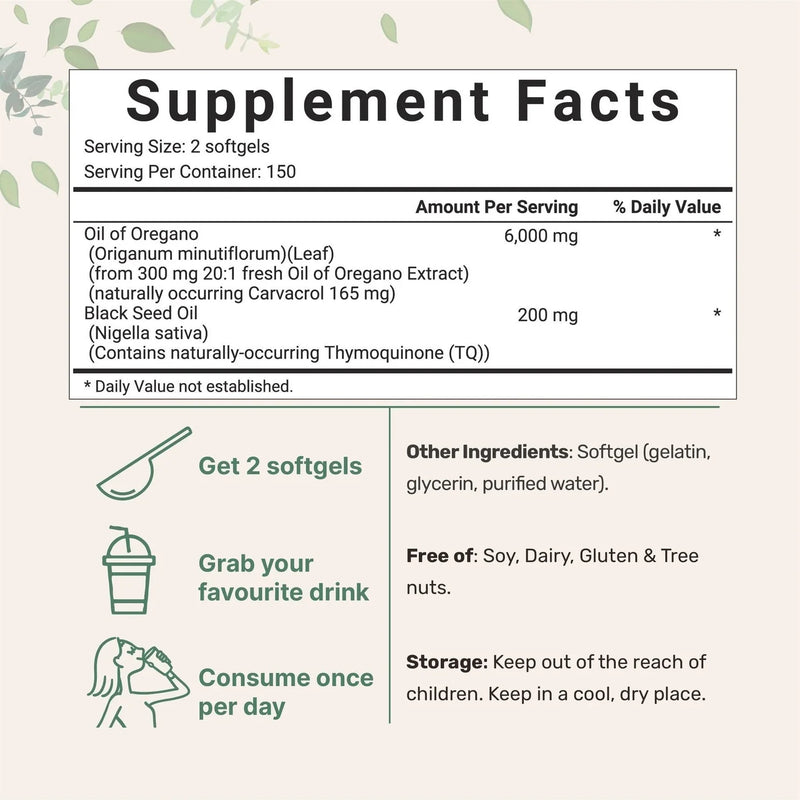
Oil of Oregano Softgels
Wild Origanum vulgare, high carvacrol, clean softgel. Every benefit in a single daily capsule.
See the Product