

Best Ceylon Cinnamon Supplement: Key Criteria That Really Matter
Five factors separate a supplement that delivers from one that just takes up shelf space. Most people never check any of them.
If you have spent time comparing cinnamon supplements, you have noticed that most look nearly identical on the front panel. Same font sizes, same health claims, same amber-toned labels. The differences that actually matter are on the back panel, and sometimes not even there. These five criteria cut through the noise and tell you whether a formula will actually work.
Criterion 1: Therapeutic Dose
This is the most important and most overlooked factor. The dose that moves the needle on blood sugar is not 500 mg. Clinical trials studying cinnamon's effect on fasting blood glucose, post-meal glucose response, and HbA1c have used doses from 1,000 mg to 6,000 mg daily. Results below 1,000 mg are inconsistent. Above 3,000 mg, effects become more reliable and stronger.
Most supplements contain 500 mg per capsule with a one-capsule daily recommendation. That is a maintenance serving of cinnamon, not a therapeutic dose. It is the amount found in a modest sprinkling of spice on food. You would not expect that to produce clinically meaningful glycaemic effects, because the research does not show it does.
A formula targeting blood sugar outcomes should deliver at least 2,000 mg per day, ideally 3,000 to 6,000 mg. A 7,200 mg daily protocol, split into two doses timed around meals, covers the full upper range of what the evidence supports while remaining entirely within safe limits for Ceylon specifically.
Read the supplement facts panel, not the front label. Find the daily serving (all capsules combined). Convert to milligrams. Anything under 1,000 mg daily is below the clinical threshold. Anything under 500 mg is symbolic.
Criterion 2: Verified Ceylon Origin
The species must be Cinnamomum verum, period. Cassia (C. cassia, C. aromaticum, C. loureiroi) contains coumarin levels that make daily high-dose supplementation risky. The EFSA has set a tolerable daily intake for coumarin that is easily exceeded by therapeutic doses of Cassia.
Ceylon contains approximately 1/1000th the coumarin of Cassia. At 7,200 mg per day, a Ceylon-based formula delivers a coumarin load well within EFSA safety guidelines. The same dose of Cassia would exceed those guidelines by a significant margin.
Verification matters too. Any supplier can print "Ceylon" on a label. The honest verification is a COA from an independent laboratory confirming Cinnamomum verum by HPLC testing and showing coumarin levels consistent with Ceylon (under 0.05 mg per gram). Without that, the species claim is self-reported.
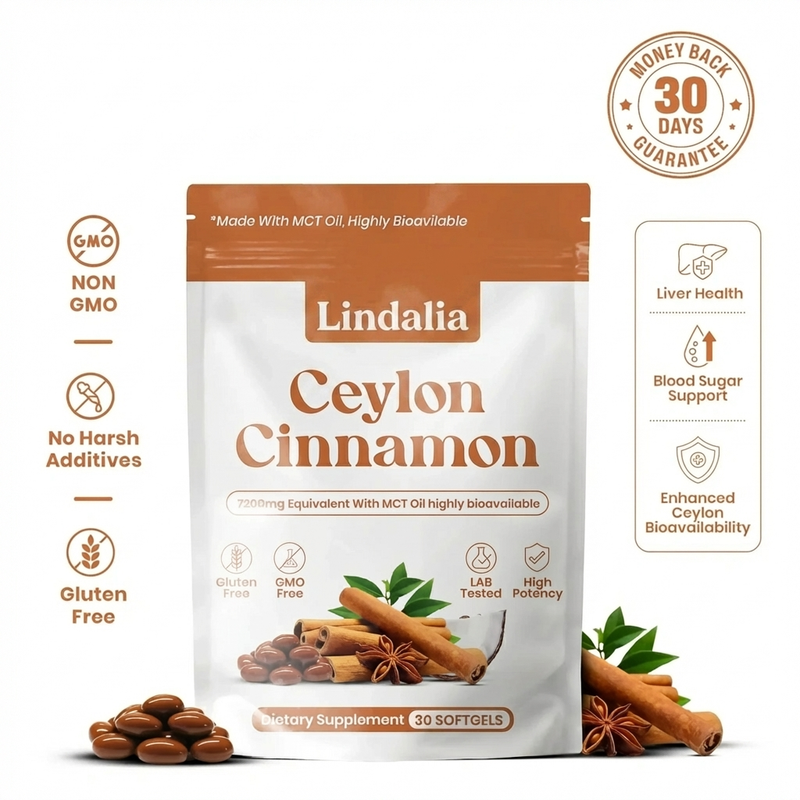
Ceylon Cinnamon 7,200mg with MCT Oil
Cinnamomum verum sourced and verified. Therapeutic dose. MCT oil, berberine, and chromium in a complete metabolic support formula.
See the ProductCriterion 3: Bioavailability Strategy
Cinnamaldehyde is fat-soluble. In a dry capsule without a lipid carrier, a significant portion of the active compound passes through the gastrointestinal tract without being absorbed. You are paying for Ceylon cinnamon and excreting a fraction of what you paid for.
MCT oil solves this. Medium-chain triglycerides form micelles in the small intestine that capture fat-soluble compounds and carry them through the intestinal wall. Plasma concentrations of cinnamaldehyde and related polyphenols are meaningfully higher when taken with a lipid source compared to without one.
This is not a minor efficiency gain. The difference between adequate absorption and poor absorption changes whether the formula produces clinical effects at a given dose. A product with MCT oil and 7,200 mg of Ceylon delivers more bioavailable cinnamaldehyde than a product with the same dose and no lipid carrier. And it provides secondary benefits: MCT ketones are a clean energy source that does not trigger insulin release, supporting the stable-energy effect users want.
Criterion 4: Synergistic Complementary Ingredients
A second ingredient is only worth including if it works through a genuinely different mechanism. Redundant stacking (three different antioxidants when one would do) is a label strategy, not a clinical strategy.
Berberine at 250 mg per day activates AMPK through a mechanism completely independent of cinnamon's pathways. AMPK activation increases muscle glucose uptake (insulin-independent), reduces hepatic glucose production, and improves insulin sensitivity at the cellular level. Combined with cinnamon's alpha-glucosidase inhibition and insulin receptor sensitisation, the two cover the glucose management problem from three directions simultaneously.
Chromium picolinate at 200 mcg addresses a fourth angle: the cofactor role in insulin signalling. Many adults in Western dietary patterns have borderline-low chromium. Correcting this supports the efficiency of insulin receptor binding. It is not dramatic as a standalone, but within a stack it closes a gap that other ingredients do not reach.
Criterion 5: Manufacturing Standards and Transparency
The first four criteria address what the formula contains. The fifth addresses whether you can trust that it actually does. Manufacturing quality and transparency are the accountability layer.
GMP-certified manufacturing means the facility operates under documented quality controls covering raw material testing, production processes, finished product testing, and labelling accuracy. Supplements manufactured in GMP facilities are far less likely to be contaminated, misdosed, or adulterated.
Transparency means the supplement facts panel shows individual ingredient doses. Proprietary blends that group ingredients under a single combined weight hide the individual quantities. If a supplement contains berberine, you need to know how much. If it lists a "metabolic blend" at 300 mg that includes berberine, chromium, and two other ingredients, you have no way to know if any single ingredient is present at a dose that matters.
Third-party testing certificates, available on request or published on the brand's website, confirm independent verification. This is the highest level of assurance available without a personal laboratory.
Price per capsule (misleading if capsule count and dose differ), generic "all-natural" claims (meaningless without specifics), celebrity endorsements, and exotic proprietary blend names that obscure what is actually inside.
"Five criteria, not fifty. Dose, species, bioavailability, synergy stack, and manufacturing transparency. Everything else is marketing."
Ceylon Cinnamon 7,200mg Formula
Therapeutic dose, verified Ceylon, MCT oil, berberine 250mg, chromium, and GMP manufacturing. Five for five.
See the Product