

Best Color Changing Foundation
for Mature Skin: Top Options Tested
Your skin at 50 is not the same as it was at 30. The foundation formula that works for it needs to understand that, too.
Finding the right foundation has always been a project. Over 50, it becomes a different kind of project. Your skin has changed in ways that make old favorites stop working. The formula that gave you a glowing finish at 35 now settles into your fine lines by 10am, and the full-coverage foundation that felt protective in your 40s now looks heavy and flat in a way that somehow makes you look older rather than more polished.
Color changing foundation offers something specifically useful for mature skin: it adapts to where your skin is rather than asking you to adapt to it. But not all adaptive formulas are designed with mature skin in mind. This article breaks down what mature skin actually needs from a foundation and which options in the color changing category come closest to delivering it.
What Changes in Skin After 50 (and Why It Matters for Foundation)
This matters because the problems are specific, and so are the solutions.
Collagen production slows. After about age 30, collagen production decreases by roughly 1% per year. By 50, the skin has meaningfully less structural support, which is why fine lines appear and why skin that was once bouncy now has more texture. Foundation that sits on top of this texture, rather than smoothing into it, will make fine lines more visible, not less.
Skin becomes drier. Sebaceous gland activity decreases with age, producing less natural oil. Skin that was combination in your 30s may be dry or dehydrated in your 50s. Foundation formulas designed for oily or combination skin, or those with matte-finish priorities, will look flat and can crease into fine lines much faster on drier skin.
Skin tone becomes more uneven. Melanin distribution changes with age and sun exposure history. Post-50, many women find their skin has more variability, specific hyperpigmentation, and a less uniform base tone than they were working with earlier. Traditional foundation shade matching becomes harder because the skin is no longer a consistent single tone.
The skin barrier thins. A thinner epidermis means foundation sits differently. It also means the acid mantle pH can shift slightly, which is important information for adaptive foundation technology.
Full-matte foundations are the most aging choice for mature skin. Matte formulas emphasize texture by creating a flat, even surface that makes fine lines appear more pronounced by contrast. A satin or luminous finish diffuses light in a way that makes texture less visible and gives skin a more youthful appearance. This is not a vanity preference. It is physics: how light reflects off the surface changes how texture reads.
What to Look for in a Foundation for Mature Skin
Before the picks, the criteria. A foundation that works well for mature skin needs to address the specific list of challenges above.
Emollient, hydrating formula. Dry skin needs a formula with hydrating carriers: glycerin, hyaluronic acid, or squalane in the base. Formulas built primarily around silicones can feel initially smooth but may emphasize pores and texture over time. A foundation with genuinely moisturizing ingredients works with mature skin's drier profile rather than against it.
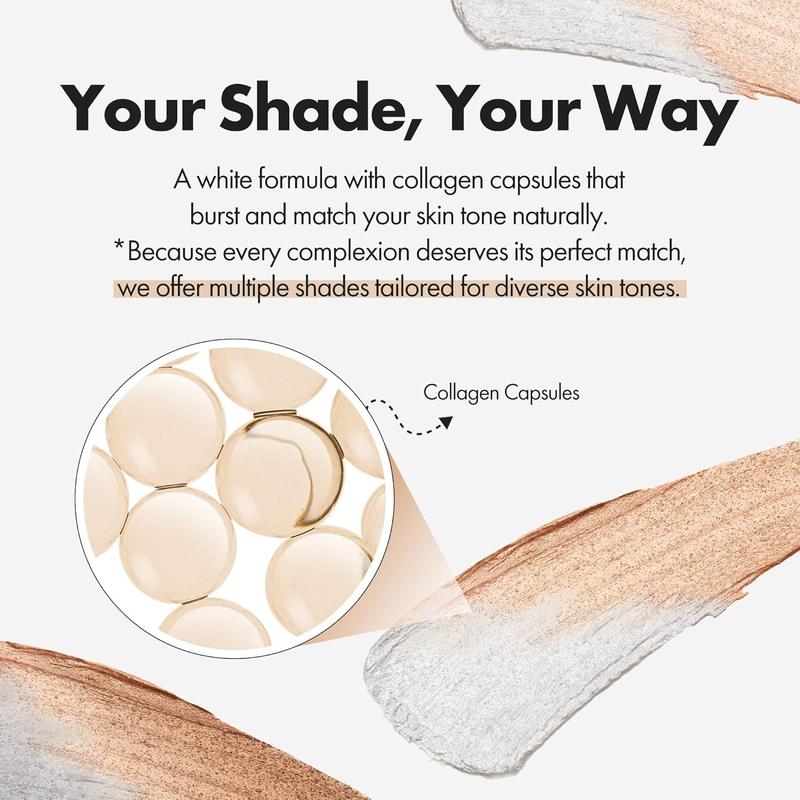
Collagen or protein film-former. Topical collagen does not penetrate deeply, but it forms a smoothing film on the skin surface that helps foundation sit over fine lines rather than inside them. This is a practical formulation choice, not a skincare cure claim. Hydrolyzed collagen in a foundation formula is worth looking for specifically because of how it affects texture interaction.
Light to medium buildable coverage. Full-coverage formulas that completely mask the skin surface tend to look heavy and flat on mature skin. The goal for most women over 50 is not to erase texture but to even tone and add radiance while letting skin breathe. Buildable light-to-medium coverage gives you control over how much to apply where.
Satin or luminous finish. As discussed, this is not optional for mature skin. Matte finishes age. Satin finishes do not.

Satin Finish, Collagen-Infused, Adaptive Color
pH-responsive pigments that adapt to your skin today. Collagen and niacinamide in the formula. A foundation that works with mature skin, not against it.
See the ProductOur Picks for Mature Skin
The collagen in this formula does what collagen in a foundation is actually supposed to do: it creates a surface film that helps the formula sit over fine lines rather than into them. Combined with niacinamide (which visibly evens tone and minimizes pore appearance over time) and adaptive pigments that read the current state of your skin rather than a fixed shade decision, this addresses most of the specific problems mature skin creates for traditional foundation. The satin glow finish hits the light-diffusing sweet spot that works best for mature skin. Full disclosure: this is the product Lindalia makes, and we believe it genuinely earns its place at the top of this category.
TLM has been around for several years and has a loyal user base. For mature skin on a budget, the lightweight formula is less likely to settle heavily into fine lines than a full-coverage traditional foundation. The adaptive range is more limited (thermochromic rather than pH-responsive), and it does not include skincare actives. But at its price point, it is a reasonable starting point for testing whether adaptive foundation works for your skin type before investing in a more sophisticated formula.
For very dry or dehydrated mature skin, serum-weight foundation formulas with high hyaluronic acid content are worth considering alongside adaptive formulas. The sheer weight of these formulas prevents them from sitting heavily in fine lines, and the luminous finish gives dry skin the radiance boost it often lacks. The trade-off is limited coverage and no adaptive color technology in most options in this category.
"At 50, you are not losing the ability to wear foundation. You are outgrowing the formulas that were not designed for your skin. The right product exists. It is just built differently than what you were using at 30."
Application Tips Specific to Mature Skin
Even the right formula works better with the right technique. Mature skin has specific application needs that differ from younger skin.
Always moisturize first, always wait. This is true for all skin types but is critical for mature skin. A hydrating moisturizer applied and then allowed to fully absorb (minimum 2 minutes, ideally 5) gives the foundation a smooth, hydrated surface to work with. Skipping this step, or applying foundation over tacky moisturizer, causes uneven pigment distribution and faster wear breakdown in fine lines.
Use a light hand and build up. Less foundation, more evenly applied, looks significantly better on mature skin than a heavy first layer. Apply in very light passes with the integrated brush, starting at the center of the face where redness and unevenness tend to be most concentrated, and feathering outward to the edges.
Do not blend over fine lines with heavy pressure. Pressing hard on fine line areas with a brush or finger pushes formula into the lines rather than over them. Light, patting motions over texture areas work better than circular buffing.
Many makeup tutorials recommend setting powder for longevity. For mature skin, powder should be used sparingly or skipped entirely. Powder settles into fine lines and exaggerates them. If longevity is a concern, a light mist of setting spray after foundation gives better wear time without the texture-emphasizing effect of powder. Apply setting spray 18-20 inches from the face, allow to dry fully before touching the skin.

The Foundation That Works With You, Not Against You
Collagen, niacinamide, adaptive pigments, satin glow. The formula mature skin has been waiting for.
See the ProductIngredients to Avoid in Foundation for Mature Skin
As relevant as what to look for is what to avoid. These are the formulation choices that consistently produce poor results on mature skin.
Heavy matte silicone bases. Silicone-heavy formulas can smooth temporarily but settle into pores and fine lines over time during the day. By afternoon, the silicone has migrated and taken the formula with it into every line on the face. This is the foundation that looks good at 9am and terrible at 3pm, and it happens more noticeably on mature skin because there is more texture for the formula to settle into.
Strong matte or oil-control formulas. These are designed for oily skin, which tends to be a younger skin problem. Using an oil-control formula on dry or normal mature skin removes what little natural moisture the skin is producing and produces a flat, cracked appearance by midday.
Very high-coverage formulas in general. The density of full-coverage foundation requires more mechanical blending to spread it, and the friction of blending over fine lines with heavy product pushes it into the lines. Light-to-medium buildable coverage achieves better results with significantly less technique required.
Foundation That Earns Its Place in Your Routine
Adaptive pigments, collagen film, niacinamide, satin finish. One product, built for what your skin needs now.
See the Product