

Best Orthopedic Pillow for Side Sleepers: Which One Fits Your Body?
Your shoulder width, your weight, where you put your arms: all of it changes what you need from a side-sleeping pillow. Here's how to match the pillow to the person.
Two people can buy the same highly rated orthopedic pillow for side sleepers. One wakes up feeling better than they have in years. The other notices no change at all. Same pillow. Completely different results. The reason is anatomy: shoulder width, body weight, arm position during sleep, and mattress softness all directly affect how much loft a side sleeper needs. Getting the right pillow isn't about finding the best-reviewed option. It's about matching specifications to your specific body.
Shoulder Width: The Primary Variable
Shoulder width is the dominant factor in determining the correct pillow loft for side sleeping. More precisely, the relevant measurement is the distance from the outer edge of your acromion (the bony point of the shoulder) to your ear when you're lying on your side. This gap varies from roughly 9 centimeters for narrow-shouldered individuals to 15 or more centimeters for broad-shouldered or heavily muscled individuals.
A simple way to estimate your gap without measuring: stand against a wall and slide a hand horizontally from your shoulder toward your neck. The number of finger-widths that fit between the shoulder tip and the base of your neck gives you a rough centimeter estimate (each finger is approximately 2 centimeters wide). Three finger-widths suggests around 6 centimeters of neck-to-shoulder gap, though the lying-down measurement will be slightly larger because the shoulder drops lower against the mattress than it sits when standing.
The practical implication: if you have broad shoulders, look for pillows with lateral loft specifications of 13 centimeters or above. Narrow-shouldered individuals will usually do better with 10 to 12 centimeters. Mid-range shoulder widths, the majority of adults, fit well in the 11 to 13 centimeter range. When a pillow doesn't specify its lateral loft, that information is essentially unavailable to you, and purchasing it for side sleeping purposes is guesswork.
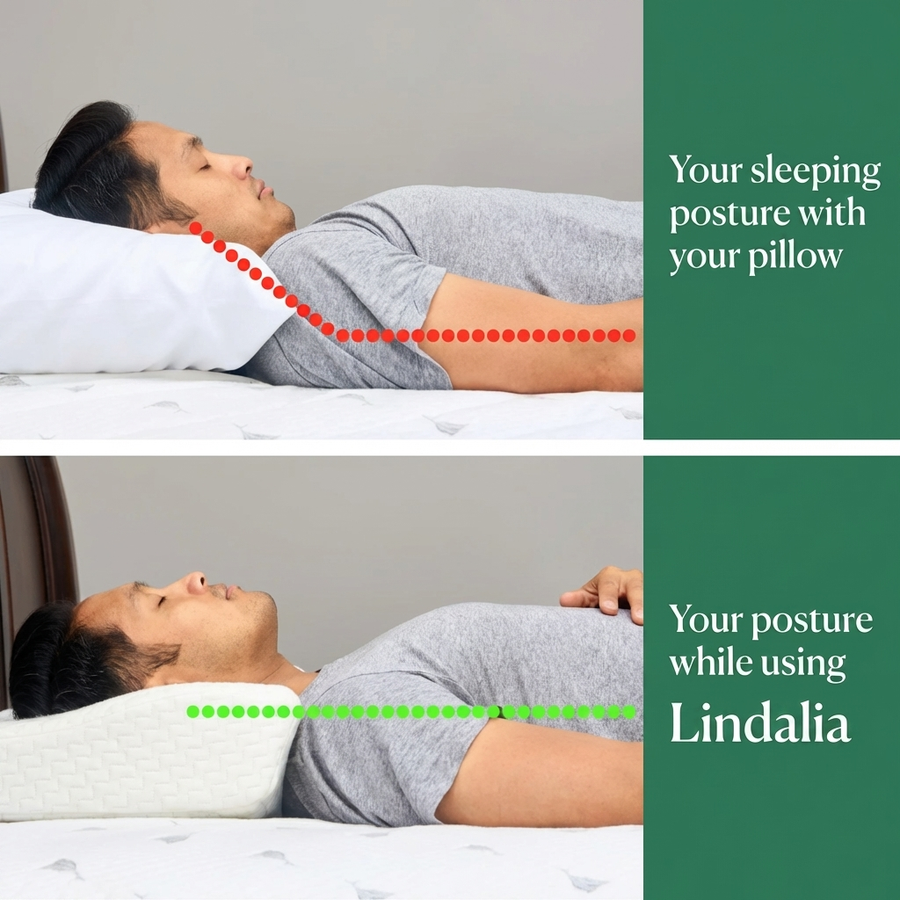
Cervical Orthopedic Pillow with Elevated Lateral Support
The dual-height contour provides meaningfully raised lateral lobes for side sleeping. Dynamic foam holds the loft precisely through the night. Free shipping.
See the ProductHow Body Weight Affects Your Pillow Choice
Body weight affects two things in the pillow equation: how much the shoulder sinks into the mattress (which affects how much the effective ear-to-shoulder gap is reduced by mattress compression) and how much downward force is placed on the pillow through the head. A heavier head exerts more downward force, which compresses a given foam density more than a lighter head would.
Adult head weight ranges from roughly 4.5 kilograms for smaller individuals to over 6 kilograms for larger ones. This is not a trivial difference when considering foam compression. A 5-kilogram head and a 6.5-kilogram head compressing the same foam to its steady-state depth will end up at different loft heights. The heavier head will compress slightly more, reducing the effective loft below the pillow's nominal measurement. For heavier individuals, choosing a pillow with a higher nominal loft than their shoulder gap measurement suggests is often correct, because the compression will bring it to the actual needed height during use.
People above 90 kilograms are also more likely to have the shoulder sink deeper into a soft mattress during side sleeping, which reduces the effective gap the pillow needs to bridge. If you're heavier and sleeping on a soft mattress, you may find that a lower-loft pillow works better than the shoulder-width calculation suggests, because the shoulder is sitting lower relative to the head than it would on a firm mattress.
Before purchasing a new pillow, assess your mattress firmness. Press your hand flat into the mattress and observe how far it sinks. A hand-width impression (4 to 5 centimeters) indicates a relatively soft mattress that will allow significant shoulder sinking during side sleeping. On that mattress, choose a pillow with 1 to 2 centimeters less loft than your standing shoulder-to-neck gap measurement suggests.
Arm Position: The Variable Most Guides Ignore
Where you put your arms during side sleeping significantly affects the optimal pillow configuration. People who sleep with the down arm extended in front of them (reaching forward) effectively raise the shoulder slightly relative to the neck, reducing the gap the pillow needs to bridge. People who sleep with the down arm tucked under the pillow or under their body compress the shoulder differently. And people who sleep with the up arm resting on the pillow affect the total weight the pillow is supporting.
If you sleep with your bottom arm reaching forward under the pillow, the shoulder's external rotation changes the shoulder-to-ear geometry significantly. The shoulder tip lifts slightly, reducing the effective gap. In this position, a pillow that's at the correct height for a neutral arm position may feel too high. Some side sleepers find that keeping the bottom arm reaching forward also helps with shoulder joint comfort, because it prevents the internal rotation that occurs when the arm is pressed against the body during lateral sleeping.
People who habitually sleep with the top arm resting on the pillow should account for the added weight in their pillow's load calculation. If both the head and a resting arm are pressing into the pillow, the actual compression will be greater than head weight alone predicts. This is a common reason why people find their pillow "works fine at first but seems to go flat" mid-night: the arm weight is contributing to faster foam compression than the nominal density would suggest for head weight alone.
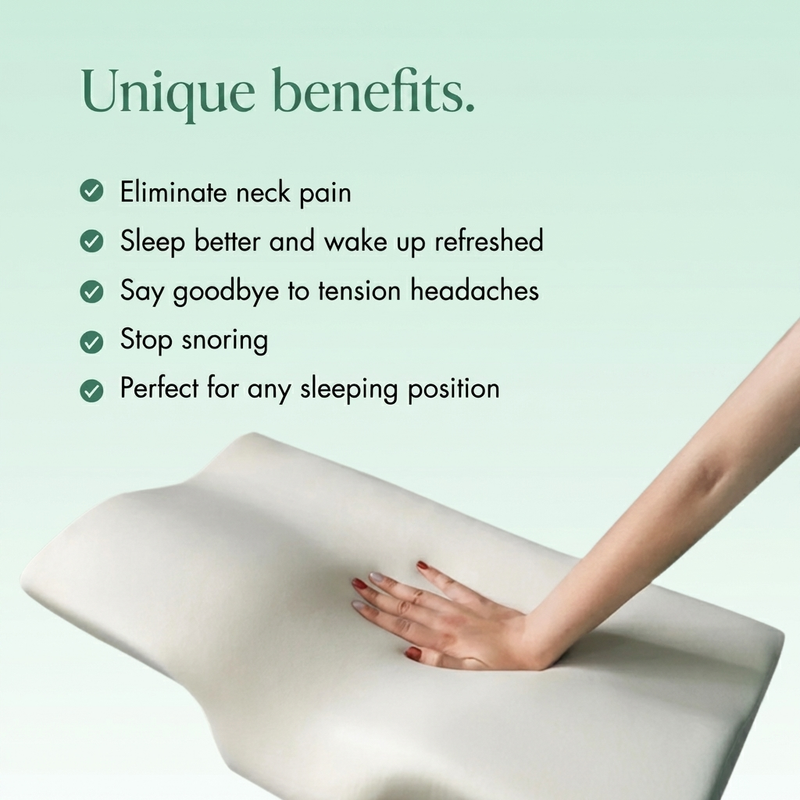
Dynamic Foam That Resists Compression Under Load
High-density memory foam maintains its loft even under combined head and arm weight, keeping your neck in neutral position through the night.
See the ProductPillow Cover Material for Side Sleepers
Side sleepers put one side of their face in sustained contact with the pillow surface for the entire night. This makes cover material more relevant for side sleepers than for back sleepers, whose face contact is more distributed. A cover that creates friction against the skin can cause the pillow to hold the head in a fixed position rather than allowing natural micro-movements, which increases the sustained load on specific cervical joints.
Low-friction covers made from silk, satin, bamboo, or high-quality Tencel allow the head to move naturally on the pillow surface without resistance. This is particularly relevant for people who have facial skin sensitivity or who notice facial pressure marks after sleeping, which indicate the cover is creating enough adhesion to prevent normal position micro-adjustments during sleep. These micro-adjustments serve a functional purpose: they redistribute pressure and prevent sustained loading of specific joint structures.
Temperature regulation in the cover also matters more for side sleepers because one ear and one side of the face is in contact with the pillow for longer periods than in back sleeping. A cover that traps heat will cause discomfort on the contact side, leading to more frequent repositioning. Moisture-wicking bamboo or Tencel covers address this by drawing heat and moisture away from the skin surface, maintaining a more comfortable contact temperature through the night.
If you start the night on your side but often wake on your back, choose a pillow where the height difference between the lateral and central zones allows both positions to feel supported. Lie on the side you prefer, check that the neck feels level. Then flip to your back and check that the cervical channel supports the curve without pushing the head forward. A genuine dual-height design should pass both tests without compromise.
The best pillow for side sleepers isn't the most popular one. It's the one whose loft matches the specific gap between your ear and your mattress.

Cervical Orthopedic Pillow for Side Sleepers
Raised lateral lobes, dynamic memory foam, dual-height design. The one that holds the right height for your shoulder width all night long.
See the Product