

Cervical Pillow Orthopedic: How to Pick the Perfect One for Your Neck
Seven concrete criteria. Check them in order. By the end, you'll know exactly what you're looking for and why, before you spend a dollar.
Most buying guides for orthopedic pillows are vague: "look for good support," "choose quality materials," "consider your sleep position." That's not a checklist. That's a sentence. What actually helps is a specific list of criteria with concrete measurements and decision points. Here are seven, ordered from most important to least, that will tell you whether any given cervical pillow is worth your money before you buy it.
Criterion 1: Foam Density (The Non-Negotiable)
Start here. A cervical pillow built from inadequate foam fails the orthopedic brief regardless of how good its shape or cover are. The density specification you're looking for is 4 pounds per cubic foot (approximately 64 kilograms per cubic meter) or above for memory foam. Below that threshold, the foam compresses too fully under head weight and loses its structural properties within hours of use, leaving your neck unsupported for the majority of the night.
Many brands don't list this number. If you can't find it in the product specifications, email the brand and ask directly. Quality foam manufacturers know their density because it's a positive differentiator. If the response is vague ("premium quality foam" or "high-density design") without a number, treat that as a red flag. The number exists. It's being withheld because it's not competitive.
Dynamic or graduated-density foam (denser core, softer surface layer in the same piece of foam) is the gold standard for cervical pillows. It provides different resistance levels across the pillow's surface without requiring multiple separate foam pieces that can separate or shift. If a brand specifies dynamic or graduated density, that's worth noting as a positive indicator, provided the base density is still adequate.

Cervical Orthopedic Pillow
Dynamic memory foam with adequate density, genuine dual-height contour, hypoallergenic certified materials. This one meets the checklist. Free shipping.
See the ProductCriterion 2: Contour Geometry (Shape Is Structure)
The second criterion is the functional contour. Look at the profile of the pillow from its side. You should see a clear height difference between the central section and the lateral lobes, and a visible cervical channel in the center that's distinctly lower than the surrounding foam. If the contour looks minimal or decorative from this angle, it's decorative in practice too.
Specific numbers to look for: the cervical channel should be 2 to 4 centimeters below the lateral lobes. The lateral lobes themselves should be raised enough to address the side-sleeping shoulder gap (typically 3 to 5 centimeters above the channel). If the brand provides these measurements, you're dealing with a manufacturer that understands the functional purpose of the contour. If these numbers are absent from the specifications, you're dealing with a product that may be contour-shaped without being contour-functional.
Also check whether the pillow has a defined dual-height design: one side lower (for back sleeping) and one side higher (for side sleeping). This is a legitimate design feature that addresses the real anatomical difference between back and side sleeping positions. A pillow that claims to work for both positions without a height difference between sides is making an impossible claim. The two positions require different loft heights. A single uniform height serves one position correctly and the other poorly.
Hold the pillow up at eye level and look at it from the end. The lateral lobes should be clearly higher than the central channel. If you squint and can barely see the height difference, the contour is insufficient. The height difference should be obvious from this angle, not something you need to measure to detect.
Criterion 3: Loft Height for Your Position
Loft is the third criterion and the most individual. There's no universal correct loft. The right height depends on your shoulder width (for side sleeping), your cervical curve depth (for back sleeping), and your mattress firmness (which affects how deeply your shoulder sinks and thus how much loft you need). Measure your shoulder-to-ear distance while lying on your current mattress to get the most accurate measurement for side sleeping loft selection.
For back sleepers, the target is typically 7 to 10 centimeters of main loft with the cervical channel 2 to 3 centimeters below that. For side sleepers, 10 to 14 centimeters of lateral loft covers the range for most adult shoulder widths, with people at the broader end of the scale needing the higher end of that range. A pillow with adjustable loft (removable inserts or layers) gives you the ability to dial in the correct height rather than guessing from specifications alone.
If a pillow doesn't specify its loft height, you're guessing. This is a basic specification that any serious orthopedic pillow manufacturer will provide. Without it, you don't have the information needed to predict whether the pillow will work for your anatomy. Absence of loft specification is not a minor omission. It's the absence of the most anatomy-specific piece of data in the decision.
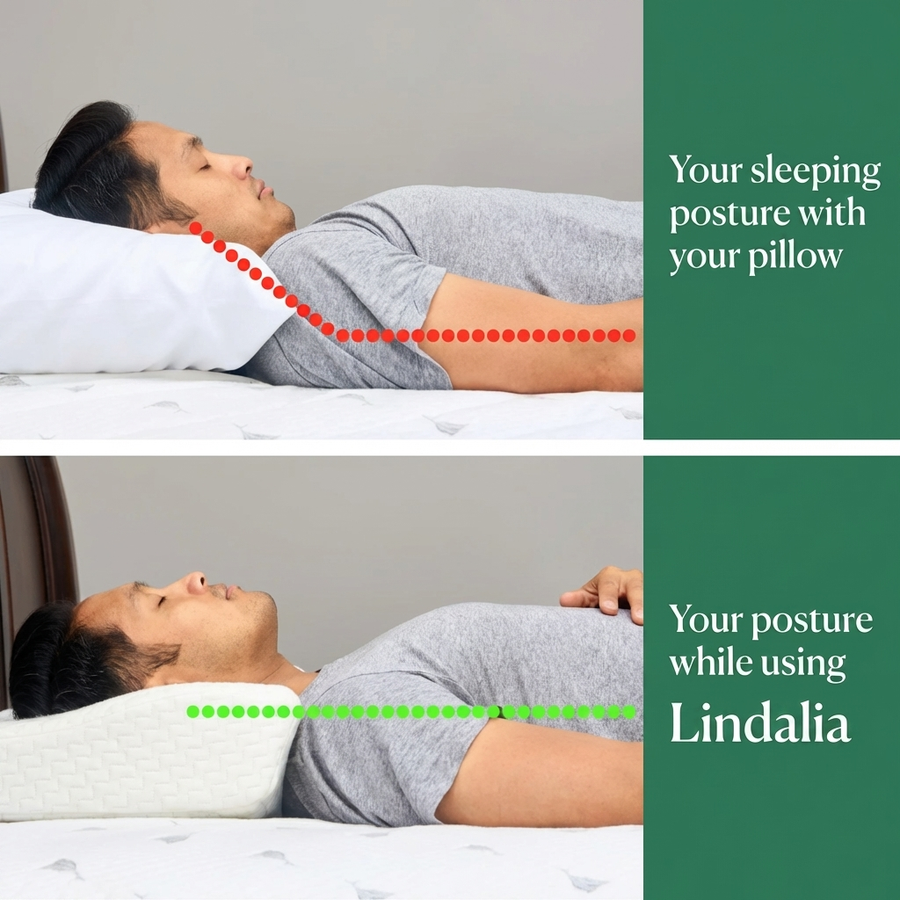
Dual-Height Contour That Adapts to Both Positions
Lower side for back sleeping, higher side for side sleeping. One pillow that gets both positions right with the right loft for each.
See the ProductCriterion 4: Material Certification
Criterion four is material safety. Memory foam is a petrochemical product that can off-gas volatile organic compounds during and after manufacture. CertiPUR-US certification (for US-sold products) confirms that the foam has been tested for specific VOCs, heavy metals, formaldehyde, and several other potentially harmful compounds, and found to be within acceptable limits. OEKO-TEX Standard 100 certification serves a similar purpose for the cover materials.
These certifications matter because you sleep with your face in contact with or near this material for eight hours every night. The cumulative exposure over months and years to even low-level off-gassing from uncertified foam is a reasonable health consideration. Certified materials have been independently tested rather than self-certified. If a brand claims their materials are safe without specifying the certifying body, that claim carries no verifiable weight.
Hypoallergenic claims without certifications should be treated with equal skepticism. True hypoallergenic performance comes from material properties (dense foam that resists dust mite colonization, covers that can be washed regularly) and is verifiable. "Hypoallergenic" as a marketing term with no backing certification describes nothing specific. Look for the actual certifications rather than the claim.
Criterion 5: Cover Washability
The cover of your pillow is in sustained contact with your skin, hair, and breath for the entire night. Without regular washing, it accumulates skin cells, hair oils, dust mites, and moisture. Dust mites are a primary trigger for allergic rhinitis, which disrupts sleep through nasal congestion and inflammation. A washable cover that's laundered at 60 degrees Celsius regularly is a basic hygiene requirement, not an optional feature.
Check that the cover is fully removable via a zipper, not just designed to be removable in principle but difficult in practice. The cover should be machine washable and designed to retain its shape and softness after repeated washing. Materials that pill, stiffen, or shrink after a few washes defeat the purpose of washability. Bamboo, Tencel, and high-thread-count cotton covers generally hold up well to regular laundering.
A manufacturer's warranty is their bet that their product will hold up. A 90-day warranty is a brand betting their pillow will be fine for three months before problems appear. A 3-year warranty is a brand betting on years of reliable performance. For orthopedic pillows specifically, where the foam density and shape maintenance are what make the product work, a longer warranty signals more confidence in foam quality. Less than one year is a minimal commitment. Two to three years is a meaningful one.
A seven-point checklist takes five minutes to apply. It saves you from buying a pillow that fails criterion one and won't tell you.
Criterion 7: Satisfaction Guarantee
The final criterion is whether the brand stands behind their product with a meaningful trial period. Orthopedic pillows need two weeks minimum to evaluate properly, because the tissues in your neck need time to adapt to a new sleeping position, and because a first-night impression tells you almost nothing about long-term performance. A brand that offers a 30-night or longer trial is implicitly acknowledging this reality and giving you the time needed to make a genuine assessment.
A 30-night satisfaction guarantee is the baseline. Some brands offer longer trials of 60 to 100 nights, which is appropriate for a product that may take three to four weeks to deliver its full benefit as tissue adaptation progresses. Return policies that require the pillow to be unused are not meaningful for a sleep product. A legitimate trial policy allows you to actually sleep on the pillow before deciding whether it works.
Free shipping on both the outbound and return directions completes the guarantee. A "satisfaction guarantee" that requires you to pay $30 to return a product you don't like is not a genuine guarantee. It's a marketing claim with a financial barrier. Real confidence in a product means absorbing the logistical cost of honoring returns, because the brand knows that returns will be rare when the product is correctly designed.
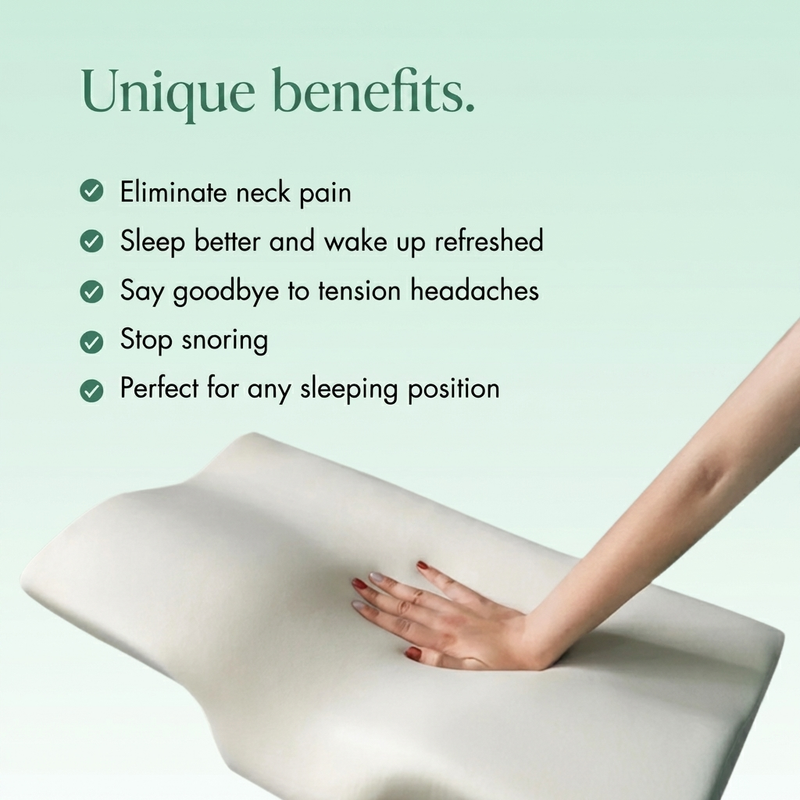
Cervical Orthopedic Pillow by Lindalia
Density specified. Contour measured. Dual-height design. Certified materials. Washable cover. Multi-year performance. Satisfaction guarantee. Free shipping.
See the Product