

Ceylon Cinnamon Supplements: Why Ceylon Is the Gold Standard
There is a reason Ceylon cinnamon costs more and is harder to find. The science behind that price difference is more important than most people realise.
Cinnamon has been used medicinally for over four thousand years. But for most of that history, the cinnamon in question was Ceylon, Cinnamomum verum, grown in what is now Sri Lanka. The Cassia variety that fills most modern supplement capsules is a cheaper substitute that became dominant through trade economics, not science. Here is why Ceylon earned the "true cinnamon" designation, and why it matters enormously for daily supplementation.
The History Behind "True Cinnamon"
Cinnamon was among the most valuable spices in ancient trade. Arab traders controlled supply routes and deliberately obscured the origin of the spice to maintain their monopoly. When Portuguese traders reached Ceylon in the 16th century, they found the original variety the world had been using, a thin, multi-layered bark with a delicate, complex flavour profile distinct from the harder, coarser Cassia they encountered elsewhere.
The Dutch took control of Ceylon's cinnamon trade in the 17th century and maintained tight control over supply. When the British eventually opened up global trade, Cassia from China and Southeast Asia, much cheaper and easier to cultivate at scale, flooded Western markets. For culinary use, the flavour difference was an acceptable trade-off for cost. For therapeutic supplementation, it turned out not to be.
In Sri Lanka, Ceylon cinnamon grows as a small tree. The inner bark is harvested after the rainy season, rolled into quills by hand, a process that is still largely manual, which explains the price premium. Each quill is a tight roll of paper-thin bark layers. Cassia bark is harvested as a single thick layer. The physical difference reflects the botanical difference: a genuinely distinct species with a distinct chemical profile.
The Coumarin Problem: What EFSA Found
Coumarin is a naturally occurring aromatic compound found in many plants, including cinnamon. In Cassia varieties, it is present in significant quantities, ranging from 1 mg to 12 mg per gram of dried bark depending on origin and processing. In Ceylon, coumarin is present at trace levels, approximately 0.004 mg per gram. That is not a minor difference. It is roughly a thousand-fold difference.
The European Food Safety Authority conducted a formal scientific opinion on coumarin in foods and supplements. Their conclusion established a tolerable daily intake (TDI) of 0.1 mg of coumarin per kilogram of body weight. For a 70 kg adult, that is 7 mg per day. A teaspoon of ground Cassia contains approximately 5 to 12 mg of coumarin. A high-dose Cassia supplement can easily exceed the TDI in a single serving.
The concern is hepatotoxicity. At repeated doses above the TDI, coumarin has been shown to cause liver damage in susceptible individuals. This is not a theoretical risk extrapolated from rodent studies at extreme doses. Human case reports of liver damage associated with high Cassia intake exist in the medical literature. The risk is dose-dependent, meaning it matters how much you take and for how long.
For occasional culinary use, Cassia poses no meaningful risk. The problem arises specifically with daily supplementation at therapeutic doses, which is the context where people expect to see blood glucose benefits. That is precisely the context where choosing the wrong species creates real risk.
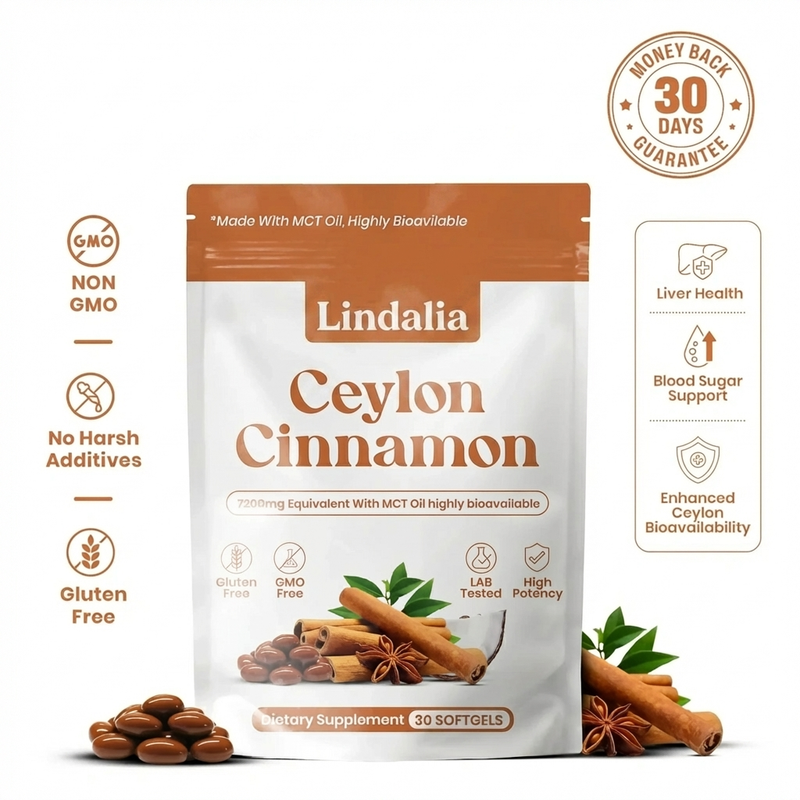
Ceylon Cinnamon at Therapeutic Dose
Cinnamomum verum from Sri Lanka, not Cassia. Safe for daily high-dose use, with less than 1/1000th the coumarin of cheap alternatives.
See the ProductThe Chemical Difference That Explains the Results
Beyond coumarin, Ceylon and Cassia differ in their cinnamaldehyde content and the full polyphenol profile. Ceylon is richer in certain flavonoids and has a more complex mixture of active compounds. This matters because cinnamon's metabolic effects are not driven by a single molecule. The synergy between cinnamaldehyde, procyanidins, flavonoids, and other polyphenols contributes to the overall insulin-sensitising and alpha-glucosidase-inhibiting activity.
When researchers standardise cinnamon extracts for clinical trials, they are trying to control for this variability. In practice, product quality varies considerably. A well-sourced, properly stored Ceylon bark will have a higher and more consistent cinnamaldehyde content than old, poorly stored material of any species.
This is part of why third-party testing for active compound content matters alongside species verification. Ceylon from a reputable source, handled correctly from harvest to capsule, is a genuinely different therapeutic tool from generic cinnamon powder.
Ceylon cinnamon may appear on labels as: "Ceylon cinnamon," "Cinnamomum verum," "Cinnamomum zeylanicum" (an older synonym), or "true cinnamon." All refer to the same species. "Cinnamon bark" or just "cinnamon" without qualification almost always means Cassia.
Why Ceylon Costs More and Why That Is Justified
Ceylon cinnamon is cultivated primarily in Sri Lanka, with smaller production in India, Madagascar, and the Seychelles. The harvesting process is labour-intensive. Workers make precise cuts in the young shoots of the cinnamon tree, carefully peel the outer bark, and roll the thin inner bark by hand into the characteristic quills. It requires skill developed over years of practice. Automated processing cannot replicate the quality of hand-rolled Ceylon quills.
The yield is also lower per tree compared to Cassia, and the trees require more careful tending. Sri Lankan production is subject to weather variability and the economic constraints of a smaller agricultural sector. All of this translates to a raw material cost three to five times higher than Cassia.
In a supplement capsule, that cost difference means a high-dose Ceylon formula is inevitably more expensive than a low-dose Cassia formula. The question is not whether Ceylon justifies the premium. Liver safety and genuine therapeutic efficacy at therapeutic doses clearly justify it. The question is whether the brand you are buying is passing genuine Ceylon quality through to the capsule, or charging a Ceylon premium for Cassia content.
Practical Implications: Choosing a Ceylon Supplement Wisely
The label says Ceylon. That is necessary but not sufficient. Here are the practical checks that distinguish a genuinely Ceylon-based formula from one using the label opportunistically.
Third-party testing should confirm both species identity and active compound content. A COA from an independent laboratory that lists Cinnamomum verum and provides a coumarin level is the strongest verification available to a consumer. Coumarin levels consistent with Ceylon (under 0.05 mg per gram) confirm authentic sourcing.
The dose matters. Ceylon at 500 mg per day is safer than Cassia at 500 mg, but it is still far below the therapeutic threshold. The safety argument for Ceylon only becomes practically relevant when you are dosing at the levels required to see blood sugar effects. A formula dosed at 7,200 mg per day using Ceylon is safe for daily long-term use in a way that the same dose of Cassia would not be.
Supporting ingredients should complement Ceylon's mechanism rather than distract from it. MCT oil for cinnamaldehyde bioavailability, berberine for AMPK activation, and chromium for insulin receptor support all work alongside Ceylon's core mechanisms without redundancy.
"Ceylon is not a premium version of cinnamon. It is the original. Cassia is the substitute that became the default through economics, not science."
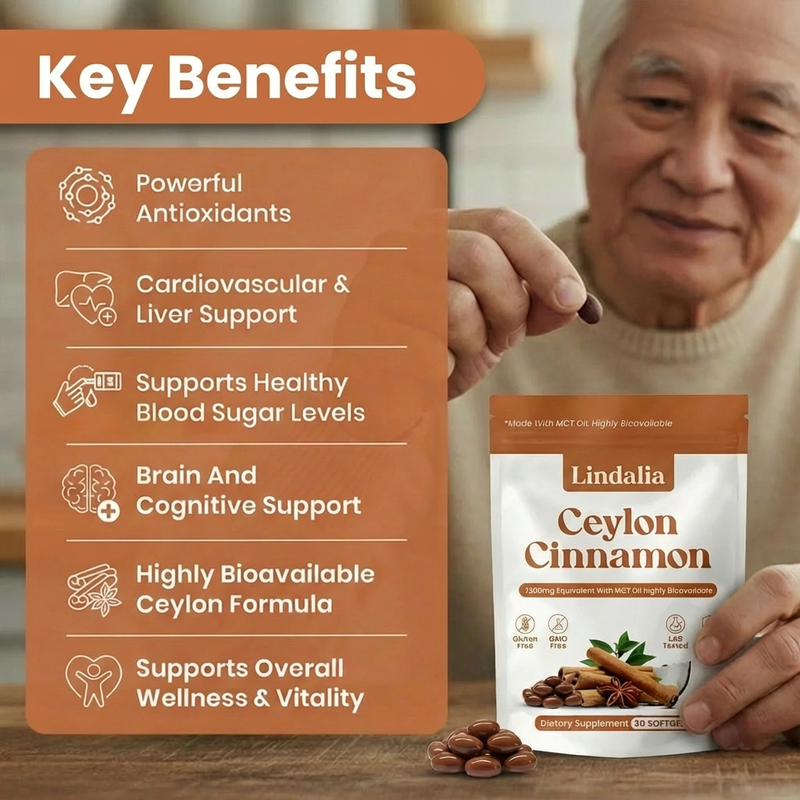
Ceylon Cinnamon 7,200mg, Verified
Cinnamomum verum at therapeutic dose, with MCT oil for absorption. The gold standard in a formula built around it.
See the Product