

Cinnamon Supplement Dosage: How Much You Really Need Daily
500mg is not enough. The clinical evidence is clear. Here is what the studies used, what the numbers mean, and what safety upper limits actually look like for Ceylon.
The cinnamon dosage question is where the supplement industry most obviously fails consumers. The most common capsule on the market contains 500 mg. The studies showing meaningful blood sugar effects used 1,000 to 6,000 mg. This is not a nuance. It is a 12-fold gap between what is sold and what has been studied. Here is the full picture, including what the safety ceiling actually looks like.
What 500mg Actually Represents
A level teaspoon of ground cinnamon contains approximately 2,500 to 3,000 mg. A 500 mg capsule is roughly one-fifth of a teaspoon. You would barely notice this amount if you sprinkled it on food. In the context of what clinical research has studied for blood sugar effects, 500 mg is a sub-threshold dose in almost every trial that showed significant outcomes.
Why do so many products use 500 mg? Manufacturing economics. Ceylon cinnamon costs more per kilogram than Cassia. A 500 mg dose is cheaper to produce than a 2,000 mg dose, even without accounting for the species switch. Consumers see "cinnamon supplement," assume the dose is appropriate, and purchase without understanding the dose-response relationship.
The clinical literature does not support a meaningful blood glucose effect at 500 mg per day in most study populations. Trials at this dose show inconsistent and often statistically non-significant effects. The researchers who ran these trials with consistent and significant results used doses starting at 1,000 mg and typically used 1,500 to 6,000 mg. This is not a selective reading of the evidence. It reflects the dose-response pattern across the literature.
The Clinical Dose Range: 1,000 to 6,000mg
The range of 1,000 to 6,000 mg daily covers most of the clinical evidence base for cinnamon and blood sugar. Within this range, a dose-response relationship exists: higher doses generally produce larger effects on fasting glucose and HbA1c, though the relationship is not perfectly linear.
At 1,000 mg per day: some studies show significant effects, particularly on post-meal glucose and in pre-diabetic populations. This is a useful minimum threshold. Below it, effects become unreliable.
At 1,500 to 2,000 mg per day: more consistent effects across populations. Fasting glucose reductions of 5 to 15 mg/dL from elevated baselines. Modest HbA1c changes at 8 to 12 weeks. Craving reduction becomes noticeable in users with meaningful glycaemic instability.
At 3,000 to 4,000 mg per day: the dose most frequently associated with larger effect sizes in meta-analyses. Fasting glucose reductions in the 15 to 25 mg/dL range in pre-diabetic populations. Significant HOMA-IR reductions indicating improved insulin sensitivity.
At 5,000 to 6,000 mg per day: upper end of most clinical trial protocols. Consistent with the above effects and in some studies producing the largest absolute changes in HbA1c and fasting glucose.
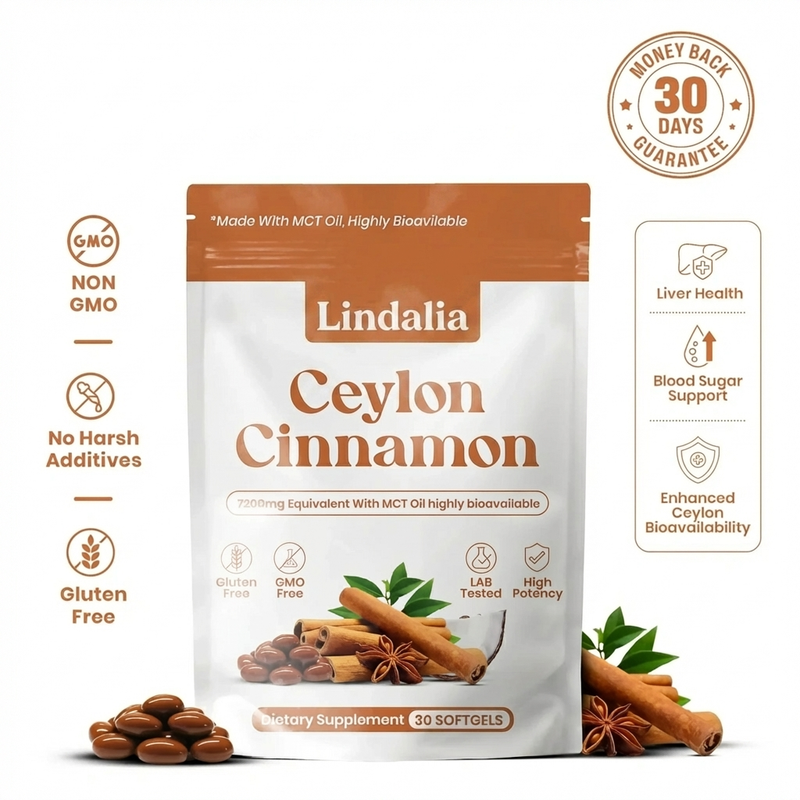
Ceylon Cinnamon 7,200mg with MCT Oil
7,200mg daily, split across two pre-meal doses. At the upper end of the therapeutic range, safely, using Ceylon where coumarin is negligible at any dose.
See the ProductWhy 7,200mg: The Rationale for the Upper Therapeutic Range
The formula at 7,200 mg per day sits above the most frequently studied range of 3,000 to 6,000 mg, but below any established safety concern for Ceylon cinnamon specifically. The rationale for this dose includes several factors.
Bioavailability is not 100%. Not all of the 7,200 mg of cinnamon in a capsule reaches the intestinal wall as active cinnamaldehyde. Some is lost in the stomach's acidic environment. Some cinnamaldehyde is volatile and may partially escape before absorption. MCT oil significantly improves absorption, but "significantly" does not mean complete. A nominal dose of 7,200 mg, enhanced by MCT oil, likely delivers an effective dose in the upper range of the 3,000 to 6,000 mg clinical window in terms of actual absorbed compound.
Covering the upper therapeutic range provides a buffer against individual variation in absorption and metabolism. People differ in gastric emptying rate, small intestinal surface area, gut microbiome composition, and enzyme expression patterns. What reaches the target enzyme varies. A higher nominal dose ensures that even individuals with somewhat lower personal absorption efficiency receive a therapeutic amount.
The split dosing of 3,600 mg twice daily aligns this dose with the two-meal timing strategy. Each pre-meal dose delivers approximately half the daily therapeutic target in a single concentrated window around each major meal. The acute alpha-glucosidase inhibition at each meal is therefore at or above the threshold dose for that specific glucose challenge.
The Safety Upper Limit for Ceylon: What It Actually Looks Like
For Cassia, the upper limit is determined by coumarin. At clinical doses (3,000 mg and above), Cassia's coumarin content reliably exceeds EFSA's tolerable daily intake for most adult body weights. This is a hard safety constraint that makes high-dose Cassia supplementation inappropriate for daily long-term use.
For Ceylon, the coumarin constraint does not apply in any practical sense. At 0.004 mg of coumarin per gram of Ceylon bark, a 7,200 mg daily dose delivers approximately 0.029 mg of coumarin. The EFSA tolerable daily intake for a 60 kg adult is 6 mg. The Ceylon coumarin at this dose represents less than 0.5% of the tolerable daily intake. You would need to take more than 200 times this dose of Ceylon to approach the EFSA threshold.
The upper limit for Ceylon cinnamon supplementation is therefore not coumarin-constrained. The practical upper limit comes from three other considerations: gastrointestinal tolerance at very high doses (which varies by individual), the absence of clinical evidence above 6,000 mg (so there is no evidence base for going higher), and cost-effectiveness (at some point, increasing dose yields diminishing returns).
Most adults tolerate 7,200 mg of Ceylon cinnamon daily without gastrointestinal issues, particularly when split across two doses with meals. A small minority may experience mild digestive discomfort at this dose, which typically resolves within a week as the gut microbiome adjusts.
Dose Adjustment Considerations
Not everyone needs to start at the full 7,200 mg. For individuals who are new to cinnamon supplementation and want to assess tolerance, starting at half the dose (3,600 mg, one dose before the largest meal) for the first week before adding the second dose is a sensible approach. Most people will have no issues at full dose from day one, but the stepped introduction is a conservative option.
People who are also taking berberine or chromium separately should account for total daily intake across all products. For berberine, the well-studied daily range is 500 to 1,500 mg. A formula containing 250 mg of berberine leaves room for additional berberine if specifically needed, or is complete as a standalone if 250 mg is the target.
People taking blood sugar medications should start supplementation under medical supervision with blood glucose monitoring. The combined effect of medication and a therapeutic cinnamon dose can produce blood glucose reductions that require medication adjustment. Several users have had their prescribing physician reduce their medication dose after stable glucose was achieved with combined supplementation. This is a positive outcome but one that requires monitoring to achieve safely.
Start at 7,200mg daily (the standard dose) if you are healthy and not on blood sugar medication. If on medication, start with one dose (3,600mg) before your largest meal and monitor blood glucose for one to two weeks before adding the second dose. Adjust with your physician as needed.
Why the Dose Gap in the Market Matters
The persistent market norm of 500 mg cinnamon supplements is a case study in the difference between compliance with supplement regulations and honest formulation for clinical outcomes. Supplement regulations do not require that products be dosed to produce clinical effects. They require that products be safe and not make unsubstantiated claims.
A 500 mg cinnamon supplement is safe. It is also, by the standard of the clinical evidence on blood glucose management, ineffective for most people. The brand can truthfully say "cinnamon supplement" on the label, add some imagery of spices and wellness, and sell a product that costs very little to manufacture.
A 7,200 mg Ceylon supplement costs more, requires sourcing a premium species at high volume, and is formulated by someone who understands why the dose matters. The difference is not marketing. It is the commitment to produce something that works.
"In cinnamon supplementation, 500mg and 7,200mg are not two doses. They are two different products, one of which has clinical evidence behind it."
Ceylon Cinnamon 7,200mg with MCT Oil
7,200mg daily of verified Ceylon cinnamon with MCT oil, berberine, and chromium. The dose the evidence points to, in the formula built around it.
See the Product