

Cinnamon Supplement for Blood Sugar: Does It Really Help?
The honest answer, with the full mechanism, the clinical evidence, and the conditions under which it works and does not. No hype, no dismissal.
This question deserves a direct, evidence-based answer rather than marketing enthusiasm or reflexive scepticism. Yes, cinnamon supplements help with blood sugar, under specific conditions. The mechanism is real, the clinical evidence is solid, and the dose and species requirements are specific. Here is all of it.
The Mechanism: Three Pathways Explained
Understanding how cinnamon affects blood sugar requires understanding the glucose-insulin system first. After you eat carbohydrates, digestive enzymes break them down into glucose. Glucose enters the bloodstream. The pancreas releases insulin in response. Insulin signals cells to take up glucose. Blood glucose returns to baseline.
Cinnamon intervenes at multiple points in this sequence.
Alpha-glucosidase inhibition: cinnamaldehyde inhibits alpha-glucosidase, the primary enzyme responsible for cleaving complex carbohydrates into absorbable glucose in the small intestine. When this enzyme is partially inhibited, glucose entry into the bloodstream is slowed. The post-meal glucose spike is lower and broader rather than sharp and tall. This reduces the reactive insulin release, which reduces the subsequent glucose drop, which reduces the energy crash and craving that follow.
Insulin receptor sensitisation: cinnamon polyphenols, particularly cinnamaldehyde and procyanidins, activate insulin receptor tyrosine kinase. This is the molecular switch that insulin turns on to allow glucose to enter cells. When cells respond more efficiently to insulin, less insulin is required to achieve the same glucose clearance. Blood glucose returns to baseline with less insulin, which has metabolic benefits beyond the immediate glucose measurement.
GLUT4 upregulation: research suggests cinnamon increases the expression of GLUT4 transporters on muscle cell surfaces. GLUT4 transporters are proteins that facilitate glucose uptake into muscle cells, partially independent of insulin. More GLUT4 on cell surfaces means more pathways for glucose to enter, reducing circulating blood glucose even when insulin signalling is impaired.
These three mechanisms operate simultaneously and on different parts of the glucose regulation system. This is why cinnamon's effects on blood sugar are more robust than single-mechanism interventions, and why a well-formulated cinnamon supplement also includes berberine (AMPK activation, a fourth pathway) and chromium (insulin cofactor, a fifth pathway).
The Clinical Evidence: What the Studies Show
The evidence base for cinnamon and blood sugar is substantial. Dozens of randomised controlled trials have examined the effect across different populations, doses, and durations. Several systematic reviews and meta-analyses have pooled this data.
Fasting blood glucose: meta-analyses consistently find significant reductions in fasting blood glucose with cinnamon supplementation compared to placebo, particularly in individuals with pre-diabetic or diabetic baseline levels. The typical reduction in well-conducted trials ranges from 10 to 30 mg/dL from elevated baselines. In individuals with normal fasting glucose, the effect is smaller because the correction is smaller.
Post-meal glucose: acute crossover studies comparing meals taken with and without cinnamon show consistent reduction in post-meal glucose peak (the spike) and in total glucose exposure over two to three hours after eating. These are direct measurements of the alpha-glucosidase mechanism in action.
HbA1c: studies of 8 to 12 weeks duration show reductions of 0.1% to 0.5% in HbA1c. This reflects genuine improvement in average blood glucose over the measurement period. In clinical terms, a 0.3% reduction in HbA1c is meaningful: it represents a real shift towards better glycaemic control.
Insulin sensitivity: studies using HOMA-IR (a fasting glucose and insulin-derived index of insulin resistance) show significant improvements after 4 to 12 weeks of cinnamon supplementation. The direction of effect is consistent: cinnamon reduces the insulin required to maintain blood glucose in range.
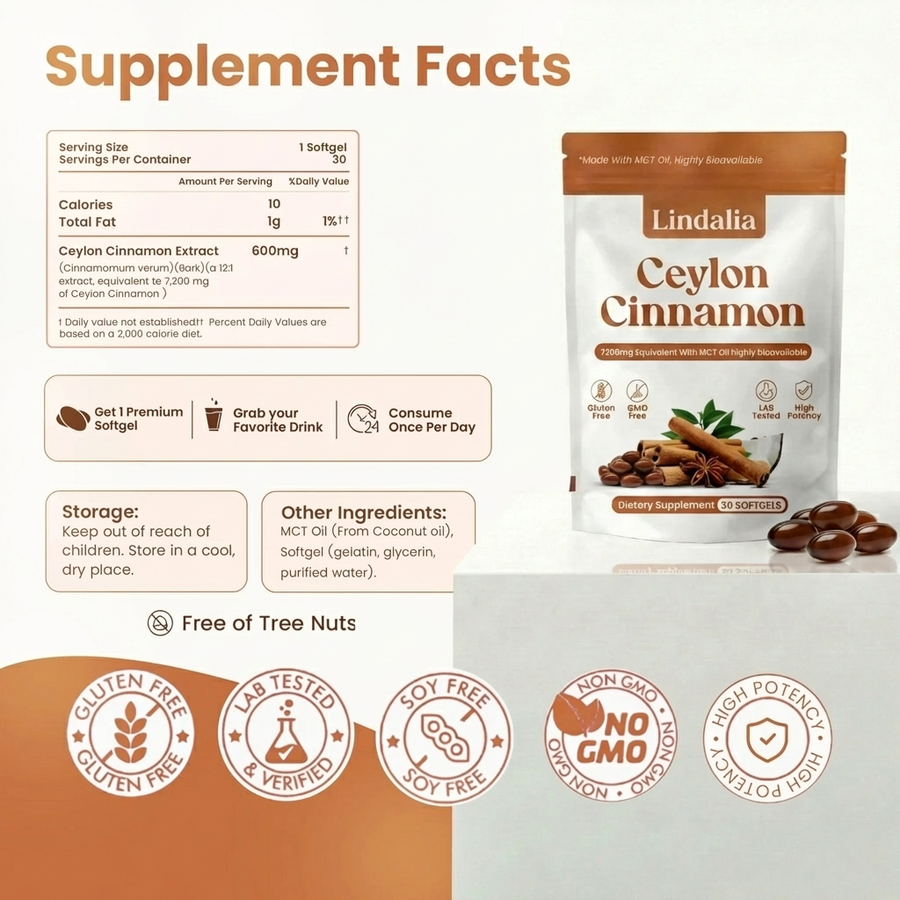
Ceylon Cinnamon 7,200mg with MCT Oil
Dosed at the level where the clinical evidence shows consistent blood sugar effects. Five pathways covered by the complete formula.
See the ProductThe Conditions: When Cinnamon Works Best
The evidence is most consistent in populations with elevated baseline blood glucose. This is not because cinnamon does not work in normal-glucose individuals; the mechanisms are universal. It is because there is more room for measurable correction when the baseline is elevated. A person with perfect glucose regulation has less to correct, so the numbers move less.
Pre-diabetic individuals (fasting glucose 100 to 125 mg/dL, HbA1c 5.7% to 6.4%) see the most consistent and clinically meaningful results. This group has measurable dysregulation that the mechanisms address directly. Clinical trials in this population show the largest and most consistent effect sizes.
People with insulin resistance, including those with PCOS, individuals in perimenopause, and overweight adults, also show strong responses. Insulin resistance is the underlying condition that cinnamon's sensitising mechanisms target most directly.
People with generally normal glucose who experience energy crashes and strong cravings after high-carbohydrate meals benefit from the acute alpha-glucosidase inhibition even if their HbA1c is well within normal range. The post-meal effects are present regardless of baseline glucose status.
The Conditions: When Cinnamon Works Less Well
High-dose cinnamon is not a substitute for insulin in type 1 diabetes or in advanced type 2 where endogenous insulin production is significantly impaired. The mechanisms require functional insulin signalling to operate fully. Where insulin production is severely compromised, insulin sensitisation has less to work with.
Liquid sugar bypasses alpha-glucosidase inhibition. Sucrose and glucose in solution are absorbed directly without requiring complex carbohydrate breakdown. A cinnamon supplement before a meal of sweetened beverages and candy will have a meaningfully smaller effect than before a meal of rice, bread, and pasta, because the primary mechanism is not relevant to simple sugar absorption.
Very low carbohydrate diets (under 50g per day) leave little for alpha-glucosidase inhibition to work on. This is not a problem, as people on very low carb diets are addressing blood sugar through dietary carbohydrate restriction rather than enzymatic modulation. The insulin sensitisation effects of cinnamon are still relevant, but the acute post-meal glucose benefit is minimal when carbohydrate intake is minimal.
The Dose Requirement: Why 500mg Is Not Enough
This is where many people's experience with cinnamon diverges from the clinical evidence. The studies showing consistent blood sugar effects used doses of 1,000 to 6,000 mg per day. The most commonly sold cinnamon supplement provides 500 mg per day. That gap is not a rounding error. It is the difference between a sub-threshold and a therapeutic dose.
At 500 mg per day, cinnamon is present in the gut but the concentration required to produce meaningful alpha-glucosidase inhibition is not reliably achieved. The studies at this dose show weak and inconsistent effects. This is not evidence that cinnamon does not work. It is evidence that 500 mg is not enough.
At 7,200 mg per day of verified Ceylon, you are at the upper end of the therapeutic range, safely, because Ceylon's coumarin content is negligible at this dose. Combined with MCT oil for bioavailability, the active compound reaching target enzymes and receptors is substantially higher than from the same dose without a lipid carrier.
Safety and Interactions: The Honest Part
For the majority of healthy adults, high-dose Ceylon cinnamon is safe for long-term daily use. The EFSA coumarin concern applies to Cassia, not Ceylon. The key interactions to know about:
Blood sugar medications: the glucose-lowering effects of cinnamon can add to the effects of metformin, sulfonylureas, or insulin. Combined use without monitoring can push blood glucose below safe levels (hypoglycaemia). This is not a reason to avoid cinnamon. It is a reason to start under medical supervision with blood glucose monitoring and to inform your prescribing physician.
Blood thinners (anticoagulants): cinnamon has mild antiplatelet properties and can interact with anticoagulant medications. If you take blood thinners, consult your physician before high-dose cinnamon supplementation.
Liver conditions: while Ceylon is vastly safer than Cassia regarding coumarin, anyone with known liver pathology should use high-dose botanical supplements with physician oversight.
"Does cinnamon help with blood sugar? Yes, at the right dose, the right species, with the right mechanism support. That answer requires all three parts."
Ceylon Cinnamon 7,200mg with MCT Oil
The right dose. The right species. MCT for absorption, berberine for AMPK, chromium for insulin cofactor. The honest answer, formulated.
See the Product