

Cyperus Rotundus Oil Hair Removal: Does It Really Slow Hair Regrowth?
Skepticism is fair. Here is what the research, the mechanism, and real user outcomes actually say about cyperus rotundus oil for slowing regrowth.
When a new ingredient shows up in the beauty space promising to slow hair regrowth, the right response is skepticism. Most products in this category make claims that fall apart under basic scrutiny. Cyperus rotundus oil is worth examining seriously, because there is an actual mechanism, actual research, and actual results to discuss. Here is what the evidence actually shows.
Why Would a Plant Oil Affect Hair Growth?
Hair growth is regulated by a cascade of biological signals inside and around the hair follicle. One key enzyme in that cascade is 5-alpha reductase. It converts testosterone into dihydrotestosterone (DHT) at the follicle level, and DHT plays a direct role in triggering the anagen phase, the active growth period of the hair cycle. When 5-alpha reductase activity is reduced, the anagen phase is delayed and the hair grows back more slowly.
Cyperus rotundus rhizome extract contains alpha-cyperone and a range of sesquiterpenes. These compounds have been shown in biochemical studies to inhibit 5-alpha reductase activity. Applied topically right after hair removal, when the follicle channel is open, the extract reaches the follicle tissue and interacts with this enzyme locally. The result is a slower restart of the growth cycle, which you experience as longer intervals between removal sessions.
This is not a hypothesis pulled from marketing copy. The inhibition of 5-alpha reductase by sesquiterpene compounds from cyperus rotundus is documented in phytochemical literature. The question is whether it works well enough at cosmetic concentrations, applied topically, to produce results you can actually feel. That is where the 2005 study comes in.
Cyperus rotundus extract inhibits 5-alpha reductase at the hair follicle. Lower 5-alpha reductase activity means a slower transition back into the anagen (growth) phase after hair removal.
The 2005 Study: What It Actually Measured
The study published in the Journal of Cosmetic Dermatology in 2005 evaluated topical application of cyperus rotundus extract on participants who had undergone hair removal. The treatment group applied the extract formulation after removal. The control group used a placebo. Both groups were evaluated over multiple hair growth cycles.
The findings: the treatment group showed a statistically significant reduction in hair regrowth compared to the placebo group. Hair density in the treated areas was meaningfully lower, and hair texture was finer in the treatment group over successive cycles. The placebo group showed normal regrowth patterns.
What makes this study worth citing is the methodology: multiple cycles, placebo control, and measurable outcomes. It is not a survey of user opinions. It is a controlled comparison with objective measurement. The results do not claim permanent hair removal. They confirm what a topical follicle inhibitor should deliver: slower, finer regrowth over time.

The Oil That Has Research Behind It
Cyperus rotundus extract with jojoba, rosehip, and tea tree. Applied after removal for cumulative results.
See the Product5-Alpha Reductase: Why This Enzyme Matters
To understand why inhibiting 5-alpha reductase works, it helps to understand what happens in the follicle after you remove hair. Waxing, shaving, and epilating remove the hair shaft but leave the follicle intact and eventually active. The follicle enters a resting phase briefly before the growth signal kicks in. 5-alpha reductase is part of that growth signal pathway.
Pharmaceutical 5-alpha reductase inhibitors like finasteride are used orally for androgenic hair loss. They work systemically, which is why they affect hair on the scalp. The principle behind cyperus rotundus oil is the same inhibition, applied locally, on zones where you want regrowth to slow rather than stop entirely. The topical approach means the effect is concentrated where you apply it, without any systemic hormonal impact.
This local specificity is actually an advantage. You can apply the oil to your bikini line without affecting any other part of your body. You can target your upper lip without touching your scalp. The oil goes where you put it and works where the follicle is exposed.
Because the oil acts topically, not systemically, it only affects the zones where it is applied. This makes it appropriate for targeted use on specific body areas without broader hormonal impact.
What Cyperus Rotundus Oil Cannot Do
It does not remove hair. You still need to shave, wax, thread, or use an epilator. The oil does not dissolve hair, kill follicles, or prevent regrowth entirely. Some zones with very fine hair may approach near-stop after many cycles, but this is not guaranteed and it is not the expected outcome.
It does not work if applied to skin that has not been recently depilated. The follicle needs to be open for the active compounds to reach it effectively. Applying the oil on top of existing hair growth provides the hydration benefit of the carrier oils but not the follicle inhibition effect.
Results take time. If you expect to apply this once and see immediate change, you will be disappointed. The mechanism is cumulative. Each cycle you apply it builds on the previous one. Most women see a meaningful difference by cycle 2 or 3. By cycle 4, the results are typically at their most pronounced.
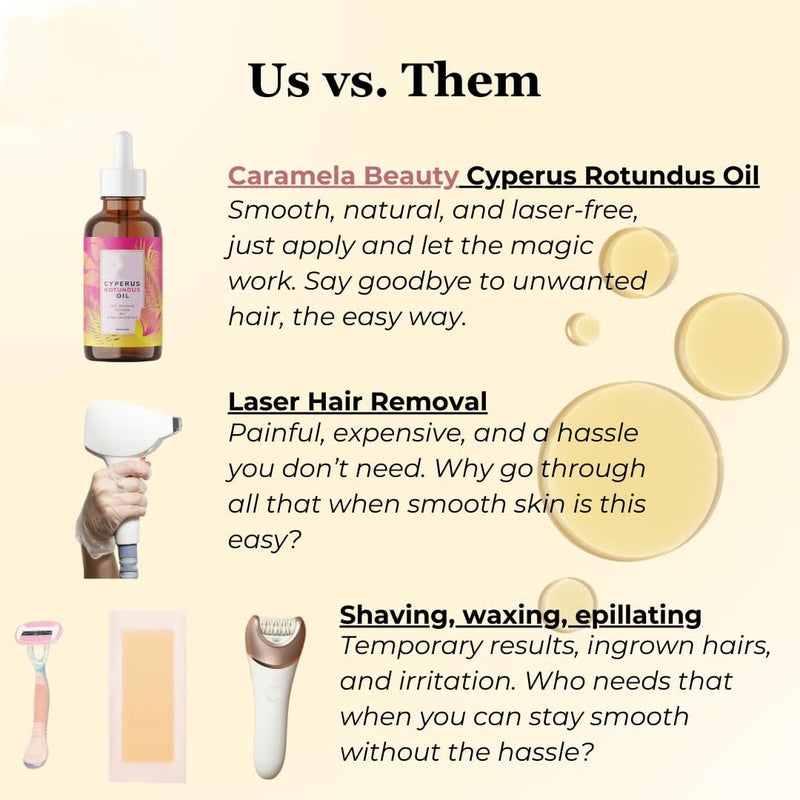
Slower Regrowth, Cycle by Cycle
Not permanent removal. A real, measurable slowing of the regrowth cycle with each application.
See the ProductWhat Users Report vs What the Research Promises
The research measures hair density and regrowth rate in controlled conditions. Users in daily life measure how many days they go between shaving sessions, whether the bikini line is smooth for their weekend plans, whether the stubble on their legs is noticeable by Thursday after a Monday shave. These are different measures, but they point in the same direction.
Most consistent users report that by cycle 2, regrowth noticeably slows. By cycle 3, some areas have shifted from a weekly to a biweekly or even monthly schedule. The hair that grows back is softer. The skin between sessions is less irritated. The ingrown hair frequency drops. These are the real-world expressions of the same mechanism the research confirms.
The Verdict
Yes, cyperus rotundus oil slows hair regrowth. The mechanism is established. The clinical evidence exists. The results are progressive and cumulative, not instant. It does not replace hair removal but it meaningfully extends the intervals between sessions and improves the quality of skin between removals. For anyone in a constant shaving or waxing cycle, that is a significant practical shift.
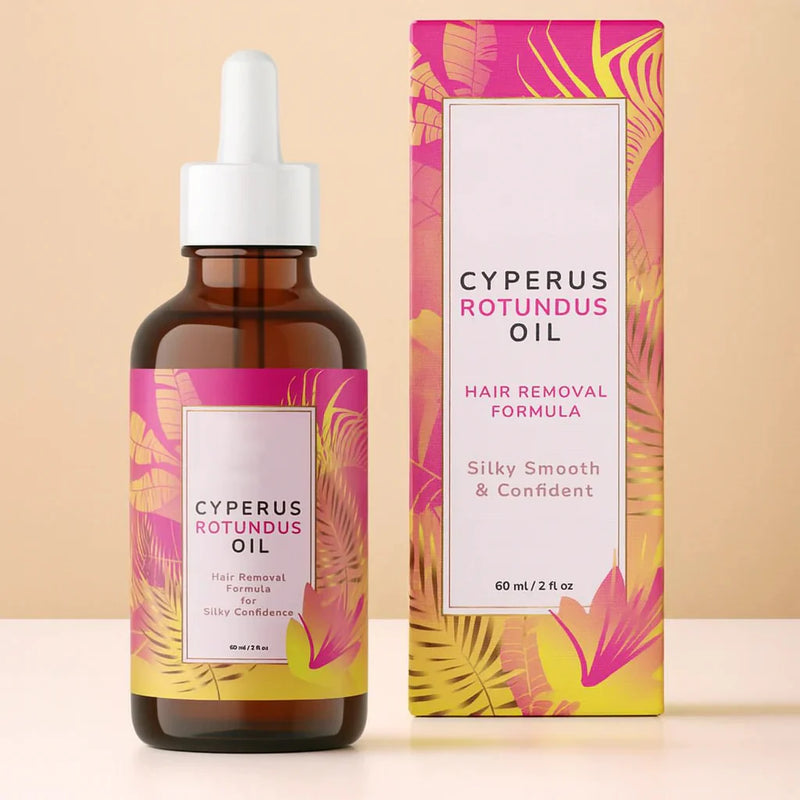
Cyperus Rotundus Hair Removal Oil
The follicle inhibitor backed by both traditional use and modern research. For all zones, all skin types.
See the Product