

Garlic Dietary Supplement: How to Choose the Right Formula
Beyond marketing claims: the scientific criteria that separate a formula that works from one that looks good on a shelf.
The word "formula" in supplement marketing usually means very little. Companies use it to imply scientific development without providing evidence of any. For garlic supplements specifically, there are concrete, measurable criteria that distinguish formulas with actual clinical support from those relying on label design and wellness buzzwords. This article walks through those criteria in order of importance.
Fermentation Time: Why 20 Months Is Not Arbitrary
The defining characteristic of aged garlic extract is the fermentation period. Not all aged garlic is fermented for the same duration, and the duration matters for the completeness of chemical conversion.
Fresh garlic contains alliin, allicin (formed enzymatically), and dozens of other organosulfur compounds. The aging process in a water-ethanol solution initiates a gradual transformation: allicin and related reactive compounds convert into S-allylcysteine (SAC), S-allylmercaptocysteine (SAMC), and other stable water-soluble compounds. This conversion is not instantaneous. Research shows that 20 months produces a substantially higher SAC concentration than shorter fermentation periods.
Why does SAC concentration matter? SAC is the most bioavailable and well-studied active compound in aged garlic extract. It is what shows up in plasma after supplementation. It is what researchers measure when studying antioxidant activity, blood pressure effects, and NK cell modulation. A garlic supplement fermented for 6 months and marketed as "aged garlic" will have a lower SAC content and correspondingly weaker clinical effects than one fermented for 20 months. The fermentation time is not a cosmetic detail. It is a core quality determinant.
Look for aged garlic extract with a specified fermentation period. '20 months' should appear in the product documentation or on the label. Vague claims about 'aged' without specifying the duration are worth questioning.
Standardization to SAC: The Marker Compound
Standardization means that the extract is tested to confirm it contains a specified minimum concentration of its active compound. For aged garlic extract, that marker compound is S-allylcysteine (SAC).
Without standardization, the potency of an aged garlic extract can vary significantly between batches. The natural variation in garlic bulbs, seasonal differences, and processing inconsistencies can all affect the final SAC content. A standardized product is tested to confirm it meets the specification before release. An unstandardized product may meet its claimed weight (say, 7,500mg) without meeting a consistent SAC level.
When evaluating a formula, look for language like "standardized for SAC" or "guaranteed minimum SAC content" on the label or in the product documentation. If the label only states milligrams without any standardization language, the active compound concentration is not being verified.
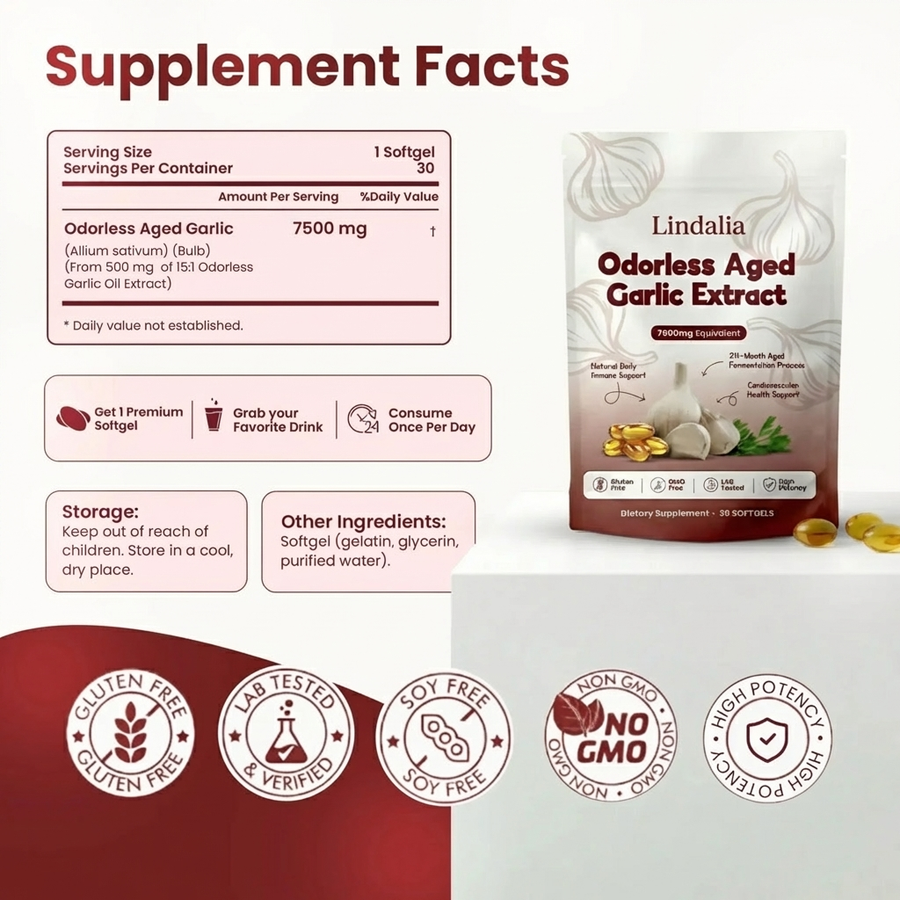
20 Months Fermented, SAC-Active
Aged garlic extract with the full fermentation period and the active compounds that clinical research measures.
See the ProductPotency Per Serving vs the Clinical Research Window
The clinical literature on aged garlic extract and cardiovascular outcomes used doses between 2,400mg and 7,200mg daily. This range comes from trials measuring blood pressure reduction, arterial stiffness, LDL oxidation, and related markers. Below 2,400mg, the evidence for cardiovascular effects thins considerably.
Most garlic supplements on the market provide 500mg to 1,200mg per serving. At these doses, you are taking a supplement with antioxidant properties but not one that matches what clinical trials used when they found measurable effects on blood pressure or cholesterol. The difference between 1,000mg and 7,500mg is not a minor variation in potency. It is the difference between a dose with clinical precedent and one without.
A formula positioned at 7,500mg potency per serving is designed to sit within the clinically studied range. This matters not only for efficacy but for realistic expectations. If someone takes 1,000mg for three months and sees no change in their blood pressure numbers, the failure may not be garlic. It may be dose.
Bioavailability: Why Softgels Beat Powder Tablets for This Compound
SAC and SAMC are water-soluble compounds. This gives them a natural bioavailability advantage over fat-soluble compounds, which require dietary fat for absorption. However, the delivery form still influences how consistently the active compounds are released and absorbed.
Compressed tablets require disintegration, which depends on the tablet binder and the stomach environment. Hard capsules are better but still require capsule dissolution. Softgels use a gelatin or vegetarian shell filled with liquid or semi-liquid content. They disintegrate reliably and quickly in the stomach, releasing the active compounds into a consistent absorption environment.
For aged garlic extract specifically, a softgel formulation ensures that the active compounds are released into the stomach or proximal small intestine where absorption is most efficient. The difference between a softgel and a compressed tablet is not dramatic for a water-soluble compound, but across months of daily use, consistency of absorption produces more consistent outcomes.
Softgels are easier to swallow than large tablets, have no strong aftertaste, and disintegrate reliably. For a supplement requiring daily use over months to show effects, eliminating small friction points matters. The best formula is the one you actually take consistently.
A formula designed around the science performs differently from one designed around the shelf. The difference shows up in the chemistry, not the packaging.
What Should Not Be in the Formula
A well-designed aged garlic extract softgel has a short ingredient list. The active ingredient is the aged garlic extract itself. The softgel shell is typically gelatin or a vegetarian alternative. A small amount of a carrier oil may be included for the fill matrix. That should be most of what is on the ingredient list.
Problematic additions include: synthetic colorants (not necessary for an oral supplement), artificial preservatives (not needed if the formulation and packaging are appropriate), proprietary blends that obscure individual ingredient amounts, and large quantities of fillers that dilute the active content per capsule volume.
There is no single filler that is dangerously harmful at typical supplement doses. The concern is cumulative: a supplement that needs many additives to hold together or maintain shelf stability is either poorly formulated or compensating for a weak active ingredient concentration. A clean formula does not need extensive filler support.
When to Take It and How to Build the Habit
Aged garlic extract is best taken with food. This is not because it causes gastric irritation (it does not, which is the point), but because meals slow gastric emptying and allow more consistent absorption of the dissolved compounds. Taking it at the same time each day with a regular meal is more important than any specific timing preference.
Morning with breakfast and evening with dinner are both valid. The compounds do not have a short half-life requiring precise timing. Daily consistency over weeks and months is what drives outcomes, not whether you take it at 8am or 8pm. If you have mild hypertension and your blood pressure tends to be higher in the morning, some users report slightly better blood pressure control taking aged garlic extract the evening before, but the evidence for this timing preference is not strong enough to be prescriptive.
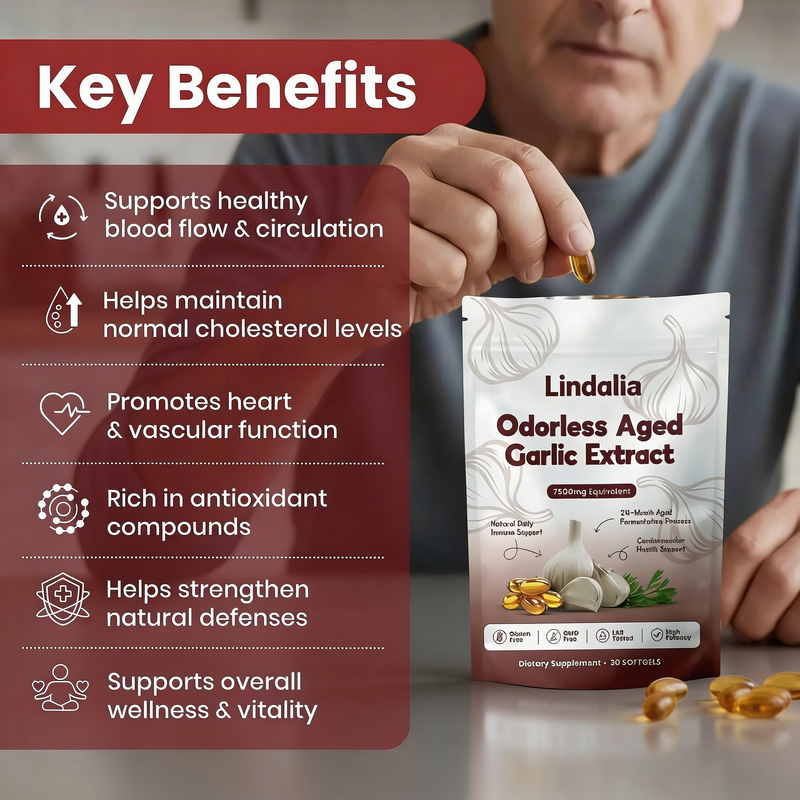
Aged Extract, Right Dose, Right Form
All three criteria met: 20-month aged garlic extract, 7500mg potency, softgel delivery. One per day with a meal.
See the ProductRed Flags in Garlic Supplement Formulas
Several patterns in garlic supplement marketing should prompt closer inspection. A label that emphasizes allicin content or "allicin yield" as a quality marker is describing a raw garlic product, not an aged extract. High allicin is not a sign of superior aged garlic. It is a sign that the fermentation process has not occurred or has been incomplete.
Labels that claim to be odorless through "advanced deodorization technology" or similar language are often masking raw garlic smell rather than producing a genuinely odorless compound. The chemistry of aged garlic extract does not require deodorization because the odoriferous compounds have been transformed, not masked.
Products with very low per-capsule doses (under 1,000mg) that recommend taking six to eight capsules per day are a compliance trap. The goal of reaching clinical dose is correct, but delivering it across eight capsules increases cost, inconvenience, and error. A well-formulated aged garlic product delivers clinical-range dose in one or two capsules.
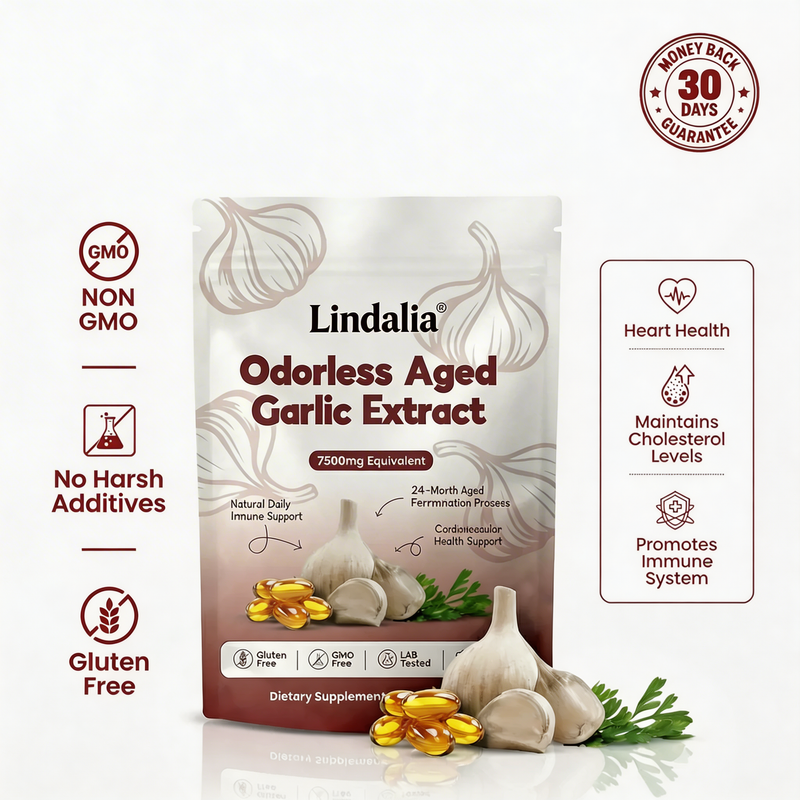
One Softgel. Clinical Dose. No Tricks.
7500mg aged garlic extract per softgel. 20 months fermented. No masking, no underdosing, no filler overload.
See the Product