

Garlic Extract Supplement: What Makes It More Powerful
Extract, powder, oil, whole clove: four different garlic formats with four different bioavailability profiles. The gap is larger than most people realize.
The word "extract" on a supplement label implies concentration and refinement. For garlic, it implies something more specific: the removal of raw plant material and the concentration of the compounds that actually enter the bloodstream. But not all garlic extracts are equal, and the difference between a standard extract and an aged garlic extract is the difference between a formulation technique and a chemical transformation.
The Four Main Garlic Supplement Formats
To understand why aged garlic extract is more powerful than the alternatives, start with what each format contains.
Whole garlic powder (dehydrated): Dried garlic cloves ground into powder and encapsulated. Contains alliin, alliinase, and dozens of other compounds. When ingested, alliinase converts alliin to allicin, but the reaction efficiency in a dry capsule is variable. The resulting allicin is unstable in stomach acid. Bioavailability is low and unpredictable.
Garlic oil (distilled): Steam distillation of garlic produces an oil rich in diallyl sulfides, primarily diallyl disulfide (DADS) and diallyl trisulfide (DATS). These compounds have antifungal and antimicrobial properties. They are fat-soluble, poorly absorbed from the gut, and the source of significant garlic odor when excreted through the skin. The oil form is not the form used in cardiovascular clinical trials.
Garlic extract (non-aged): A solvent-based extraction that concentrates the sulfur compounds from garlic without the aging step. More concentrated than powder, but still based on allicin-generating compounds that are unstable in the gastrointestinal environment. "Extract" without "aged" is a concentration technique, not a transformation technique.
Aged garlic extract: The 20-month water-ethanol fermentation that converts allicin and related unstable compounds into S-allylcysteine (SAC) and S-allylmercaptocysteine (SAMC). Water-soluble, stable, odorless, well-absorbed. The form used in clinical trials for cardiovascular and immune outcomes.
A garlic extract concentrates the compounds in raw garlic. An aged garlic extract transforms them. The biological activity that matters for cardiovascular and immune outcomes comes from the transformation, not just the concentration.
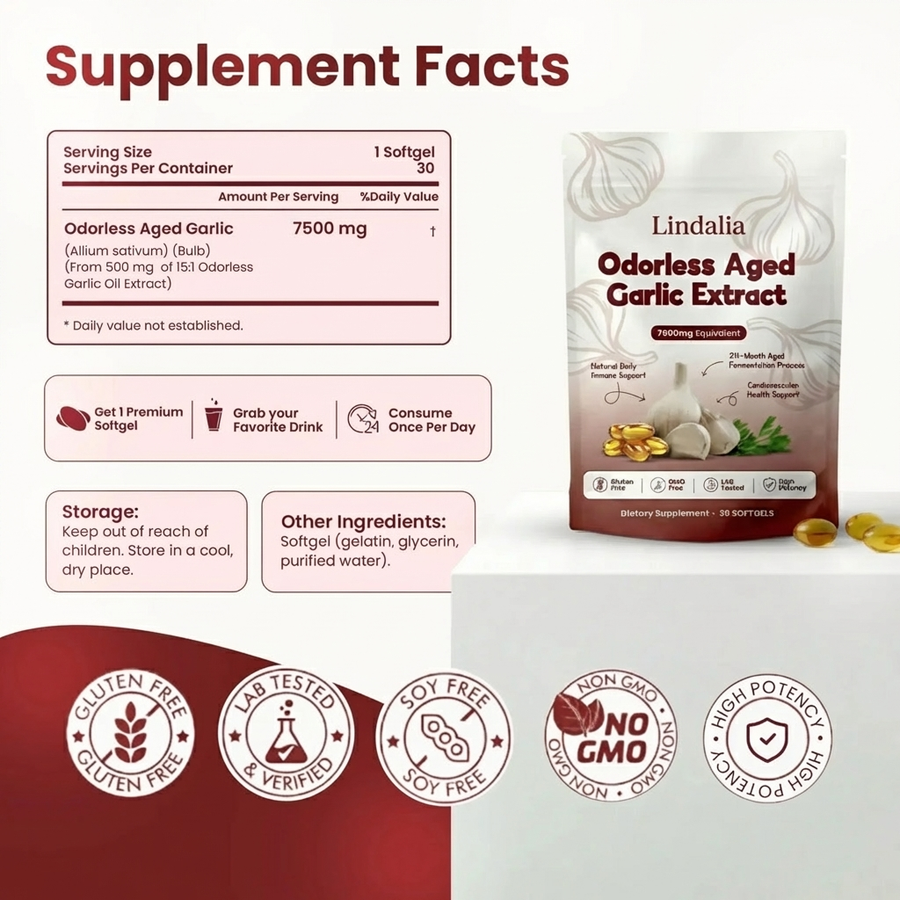
The Transformation That Makes It Powerful
20 months of fermentation converts raw garlic chemistry into bioavailable SAC and SAMC. 7500mg per softgel.
See the ProductBioavailability: The Number That Changes Everything
Bioavailability is the fraction of an administered compound that reaches the systemic circulation in an active form. For garlic compounds, the bioavailability gap between formats is one of the largest in common supplement categories.
Allicin from raw garlic powder: highly variable, typically low, ranging from minimal to roughly 30 percent bioavailability depending on the formulation and individual gastric conditions. The instability of allicin in acid means most does not survive to be absorbed.
SAC from aged garlic extract: consistently high bioavailability, measured at 60 to 90 percent in pharmacokinetic studies. SAC is a water-soluble amino acid derivative that survives gastric transit, is absorbed in the small intestine via amino acid transport mechanisms, and appears in plasma at predictable concentrations within 1 to 2 hours of ingestion.
This gap has direct consequences. A product containing 1,000mg of garlic powder delivers far less bioavailable active compound than a product containing 7,500mg of aged garlic extract, even though the first appears to have better dose per milligram of cost. The raw weight comparison is meaningless when bioavailability differs by a factor of three to ten.
What Water Solubility Means for Absorption
The water solubility of SAC and SAMC is a primary reason they are better absorbed than allicin-based compounds. The absorption of water-soluble compounds in the gastrointestinal tract relies on carrier-mediated transport and passive diffusion across aqueous mucosal surfaces. Both mechanisms are efficient and consistent.
Fat-soluble garlic compounds like the diallyl sulfides in garlic oil require bile emulsification before they can be absorbed. This process is slower, requires the presence of dietary fat, and produces more variable absorption depending on meal composition and individual digestive function.
The water-solubility of aged garlic extract compounds means they absorb effectively with or without food, across a wide range of gastric conditions, and with minimal individual variation. This is why clinical trials using aged garlic extract produce more consistent results than trials using raw garlic preparations: the active compound is absorbed predictably, which allows dose-response relationships to be established.
Although SAC absorbs well regardless of food intake, taking aged garlic extract with a meal slows gastric emptying and allows slightly more extended contact between the dissolved compounds and absorptive surfaces. The difference is modest, but it is a reason for the standard recommendation to take with food.
Bioavailability is not a detail. It is the variable that determines whether a supplement dose reaches the tissue where it needs to act, or passes through without doing anything.
Potency vs Dose: Two Numbers That Both Matter
Potency and dose are sometimes used interchangeably on garlic supplement labels, but they represent different things. Potency refers to the weight of the active ingredient. Dose refers to the amount consumed per serving. When a label says "7,500mg potency," it means 7,500mg of aged garlic extract per serving, which is the dose you receive.
Some labels use "equivalent potency" claims, stating something like "equivalent to 10,000mg of fresh garlic." This is a marketing conversion based on water content: fresh garlic is mostly water, so 10,000mg of fresh garlic becomes a much smaller amount of dried concentrate. These equivalency claims are not regulated and do not reflect the actual weight of active compounds in the capsule. They should be ignored when comparing products.
What matters is the actual milligrams of aged garlic extract per serving, measured after processing. At 7,500mg per serving, you are consuming a dose that falls in the range where clinical trials found effects. At 500mg of garlic powder per serving, you are consuming a dose that has no clinical precedent for the outcomes most buyers are seeking.
The Stability Argument: Why Your Supplement Should Work in Six Months
Stability over time is another area where aged garlic extract outperforms raw garlic powder. SAC and SAMC are chemically stable compounds that do not degrade significantly under normal storage conditions over the typical product shelf life. The antioxidant activity of aged garlic extract remains consistent from production to use.
Raw garlic powder supplements lose allicin-generating capacity over time as the alliinase enzyme degrades in the capsule. A bottle of raw garlic powder capsules purchased near its expiration date may have substantially less allicin-generating capacity than the same product fresh off the production line. This adds another layer of variability to an already unpredictable delivery system.
For aged garlic extract, the active compounds are already in their stable final form when the capsule is produced. There is no enzymatic reaction to degrade, no volatile compound to lose. The SAC you purchased is the SAC that will be in the capsule twelve months later.
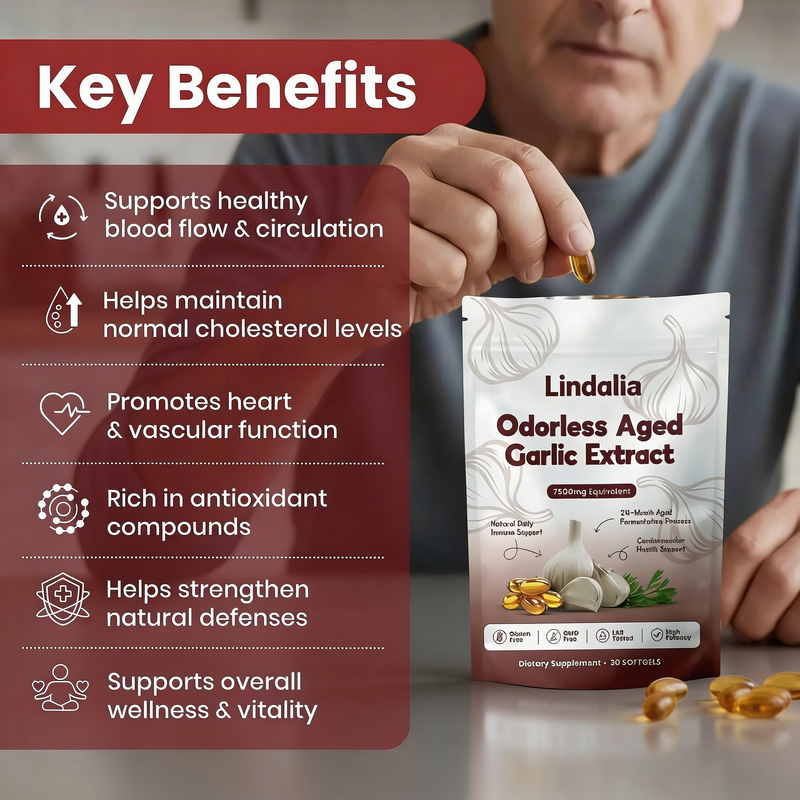
The Extract That Actually Gets to Work
SAC and SAMC formed during 20-month fermentation. Water-soluble, stable, clinical-range dose in one daily softgel.
See the ProductComparing Formats: A Practical Summary
For someone choosing between garlic supplement formats, the practical summary is this. Garlic powder is the least expensive and the least bioavailable. Garlic oil has some antimicrobial and antifungal applications but is not the form used in cardiovascular research. Non-aged garlic extracts are concentrated but not transformed, offering modest improvement over powder. Aged garlic extract is the only format with a documented clinical record for blood pressure, LDL oxidation, arterial stiffness, and NK cell activity at specific doses.
If your goal is cardiovascular support or immune maintenance based on the evidence in peer-reviewed literature, aged garlic extract at 7,500mg per serving is the format and dose that maps onto what was studied. Other formats can play supporting roles, but they cannot replicate what aged garlic extract has been documented to do at clinical doses.
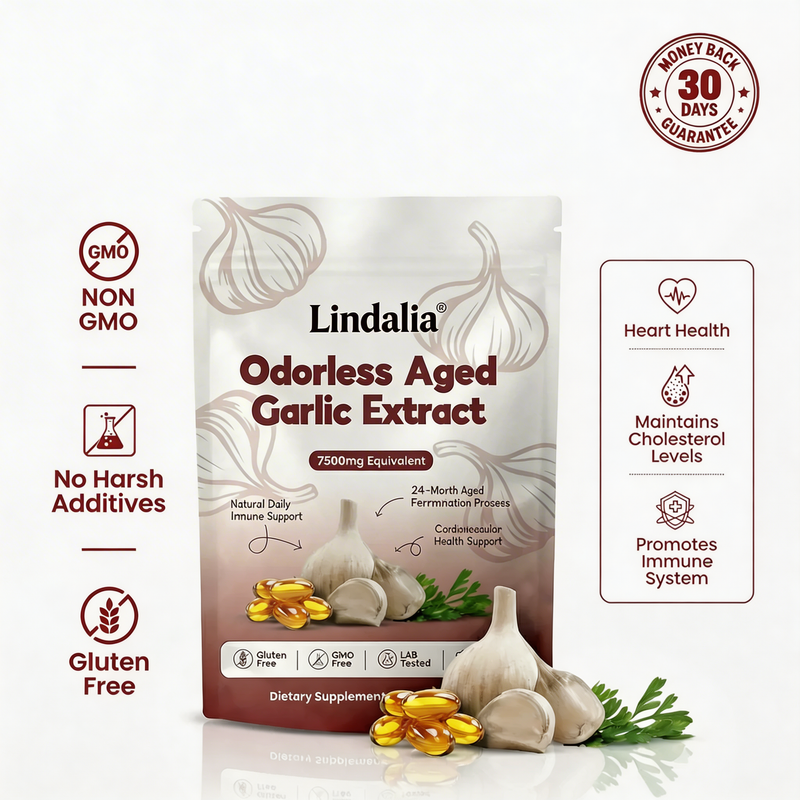
7500mg. Aged. Bioavailable. Clinical.
Not a garlic powder. Not a garlic oil. Aged garlic extract: the transformed, water-soluble, clinical-range formula.
See the Product