

Garlic Supplements: What to Look For Before You Buy
The label says garlic. The dose says 500mg. The marketing says everything. Here is what actually matters when you read the fine print.
Most people buying a garlic supplement pick the one with the most five-star reviews and a reasonable price. This approach misses the three things that actually determine whether a supplement does anything: the form of garlic used, the dose per serving, and what the label is not telling you. This is a practical checklist for evaluating garlic supplements before you spend money on something that will sit in a drawer after two weeks.
The First Question: Aged Extract or Raw Garlic?
This is the most important filter on the label, and most products do not make it obvious. Raw garlic supplements are dried or powdered garlic in capsule form. They contain allicin (or alliin plus the enzyme to create it), the same compound that gives fresh garlic its sharp smell. Allicin is reactive and unstable. It breaks down in the stomach before meaningful absorption occurs. The gastric irritation, the garlic burps, and the smell through your skin: these are not just inconveniences. They are signs of poor bioavailability.
Aged garlic extract is produced by soaking fresh garlic in a water-ethanol mixture for approximately 20 months. During this process, allicin and related unstable compounds convert into S-allylcysteine (SAC) and S-allylmercaptocysteine (SAMC). These are water-soluble, stable, odorless, and absorbed well in the gastrointestinal tract. The fermentation does not reduce potency. It changes the potency into a form the body can actually access.
When reading a label, look for the words "aged garlic extract" specifically. "Garlic extract" alone does not mean aged. "Odorless garlic" without specifying aged may mean enteric-coated raw garlic, which delays smell but does not improve the underlying bioavailability or the chemistry.
The label should say 'aged garlic extract' with a specified potency in milligrams. If it says 'garlic powder,' 'garlic concentrate,' or just 'garlic extract' without specifying aged, you are likely looking at a raw garlic product regardless of what the marketing copy claims.
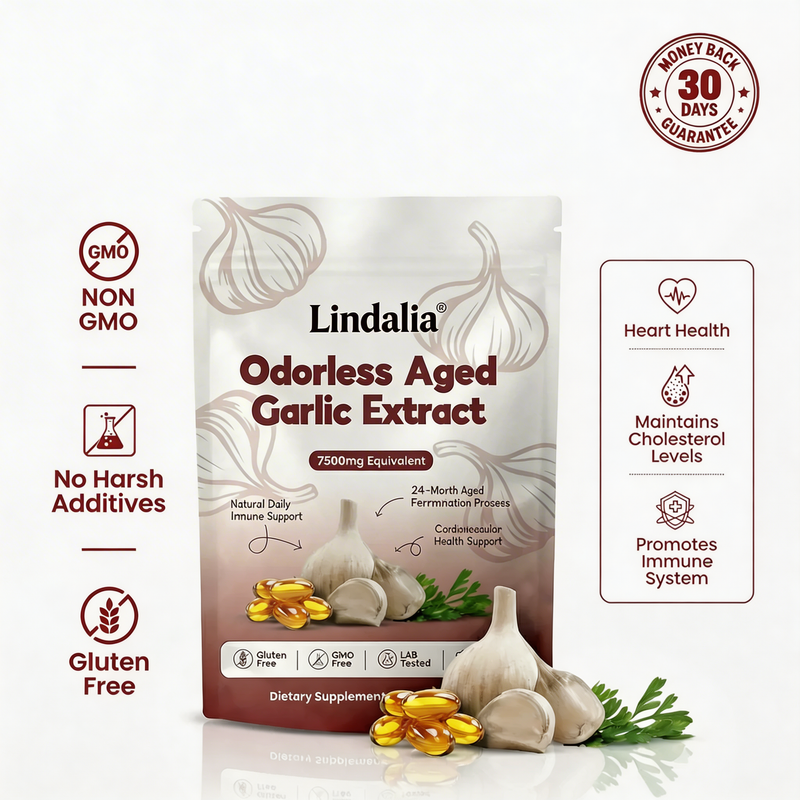
Verified Aged. 7500mg Potency.
Fermented 20 months. SAC and SAMC confirmed. No enteric coating tricks, no raw garlic dressed up as odorless.
See the ProductThe Dose Reality Check
This is where most supplements on pharmacy shelves fall short, and the failure is significant. Clinical trials that demonstrated meaningful cardiovascular effects from aged garlic extract used doses between 2,400mg and 7,200mg per day. The studies showing blood pressure reduction, LDL oxidation reduction, and NK cell improvement all fall within this range.
Now check the dose on a typical garlic supplement. Most contain 500mg to 1,000mg per serving. Some list 1,200mg as a high-dose option. At 1,000mg, you are taking roughly 14 to 24 percent of the clinically studied dose. That is not a therapeutic dose. That is a wellness gesture.
A supplement providing 7,500mg potency per serving is at the upper end of what has been studied for cardiovascular endpoints. This does not mean more is infinitely better. It means that 7,500mg is the range where the clinical research actually found effects, and 500mg is not.
The Odorless Claim: What It Really Means
Many garlic supplements advertise themselves as odorless. The mechanism behind this claim varies considerably, and the distinction matters.
Enteric-coated raw garlic capsules use a coating that prevents the capsule from dissolving in the stomach. The idea is that the garlic reaches the intestine before releasing, avoiding the stomach-acid reaction that creates the smell. This works partially for breath odor, but it does not eliminate the skin-secreted smell that comes from systemic absorption of garlic compounds. More importantly, it does nothing to improve the chemical stability or bioavailability of the allicin itself.
Truly odorless garlic is aged garlic extract. The reason it has no smell is not a coating or a deodorization step. The smell is gone because the odoriferous compounds have been chemically transformed during fermentation. SAC and SAMC do not smell. They have no volatile sulfur compounds. The odorlessness is a natural consequence of the aging process, not a masking technique.
A supplement you stop taking does not work. Studies consistently find that gastric discomfort and persistent odor are the top reasons people abandon garlic supplementation. Aged garlic extract solves both problems at the source rather than through workarounds.
Softgels vs Capsules vs Tablets: Which Delivery Form Is Better?
For aged garlic extract specifically, softgels offer a meaningful bioavailability advantage. SAC and SAMC are water-soluble, so they absorb well regardless of delivery form. However, softgels disintegrate more reliably than hard capsules or compressed tablets, ensuring the active compounds reach the absorptive surface of the small intestine consistently.
Hard capsules are acceptable for aged garlic extract but depend on capsule integrity. Compressed tablets often use binders and fillers that can slow disintegration. For a water-soluble compound like SAC, this matters less than for fat-soluble compounds, but consistency of disintegration still affects reliability of dosing.
If a product uses softgels and specifies aged garlic extract at clinical-range potency, the delivery form is optimized. If it uses enteric-coated tablets with raw garlic powder, both the form and the delivery are suboptimal.
The difference between a supplement that works and one that does not is often in the form of garlic used, not the marketing on the front of the bottle.
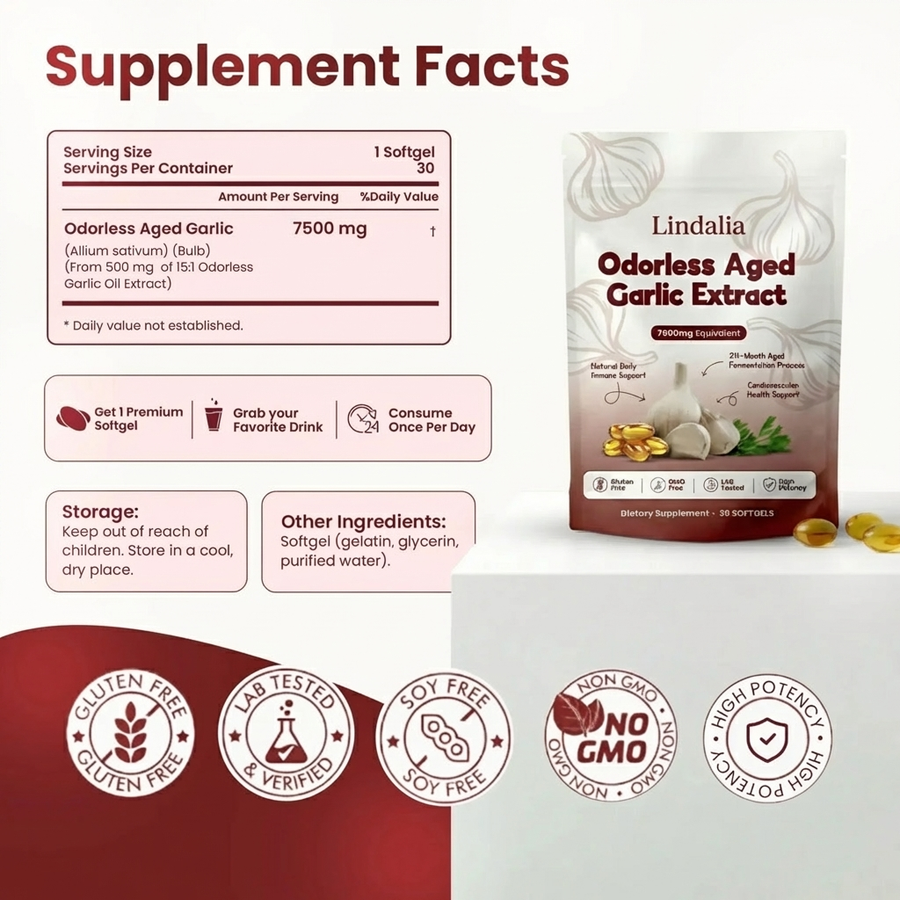
Softgel Delivery, Clinical-Range Dose
Aged garlic extract in softgel form. 7500mg potency. No fillers. No enteric-coating workarounds.
See the ProductThird-Party Testing and GMP Certification
These are not glamorous criteria, but they matter. A supplement that claims 7,500mg of aged garlic extract on the label should be able to verify that claim through third-party testing. Without independent verification, potency claims on supplement labels are unregulated.
Good Manufacturing Practice (GMP) certification means the facility that produces the supplement follows standardized procedures for quality, cleanliness, and accurate labeling. NSF International, USP, and similar organizations certify facilities and products against these standards. A GMP-certified product is not guaranteed to be effective, but it is produced under conditions where what the label says matches what is in the bottle.
When evaluating a garlic supplement, look for GMP certification on the label or manufacturer website, and check whether the company provides a certificate of analysis (COA) for each batch. A company confident in its product shows its testing results. A company that deflects these questions with marketing copy is a flag worth noting.
Before purchasing any garlic supplement, confirm: (1) Label says 'aged garlic extract' specifically. (2) Dose is 2,400mg or higher per serving. (3) Form is softgel or verified disintegrating capsule. (4) Facility has GMP certification. (5) No claim of odorlessness through enteric coating alone.
Fillers, Binders, and What Should Not Be in the Capsule
The active ingredient is only part of what is in a supplement capsule. Fillers, binders, flow agents, and preservatives make up the rest. Common ones include magnesium stearate (a flow agent used in most supplements, considered safe at standard doses), silicon dioxide (another flow agent), microcrystalline cellulose (a binder), and various coatings.
None of these are dangerous in typical supplement doses, but they do occupy volume. A product with a high filler load delivers less active ingredient per capsule size. For aged garlic extract at 7,500mg potency, the active compound should dominate the formulation. The ingredient list should be short. A supplement requiring a paragraph of inactive ingredients to explain what is in the capsule is not a clean formulation.
Look for a short inactive ingredients list. Rice bran, gelatin (for the softgel shell), and minimal flow agents are typical for a clean aged garlic extract softgel. If you see more inactive ingredients than active ones, or if the capsule contains compounds you cannot identify, that is a reason to keep looking.
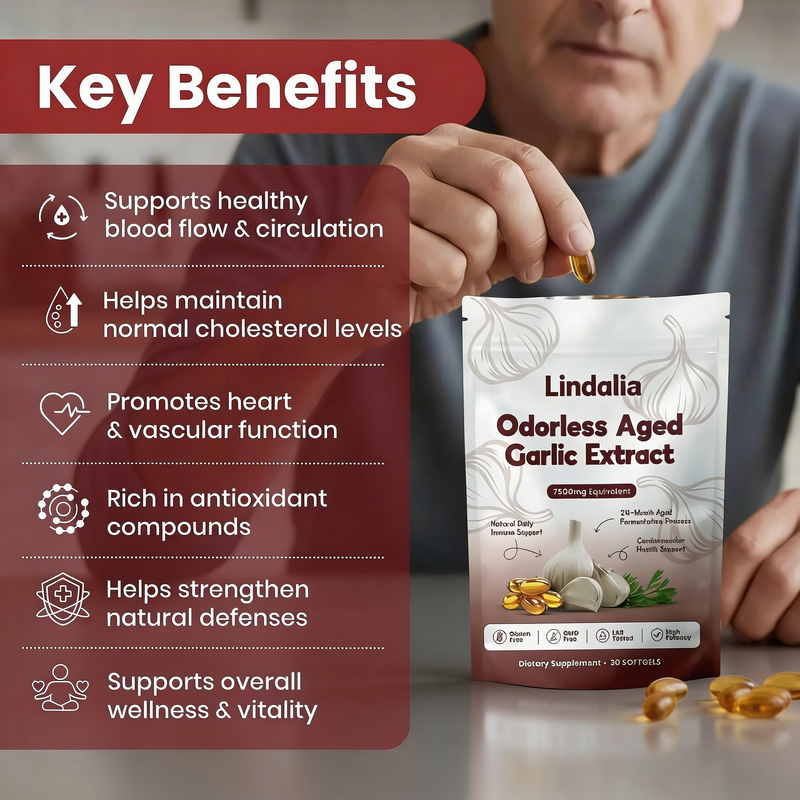
What Is on the Label Is What Is in the Capsule
Aged garlic extract, 7500mg potency, softgel form. Short ingredient list, GMP standards.
See the Product