

Oil of Oregano Supplement: Everything You Need to Know
From ancient Mediterranean medicine to peer-reviewed antimicrobial research, a complete reference on what oil of oregano actually does and how to use it well.
Oil of oregano is one of the most studied natural antimicrobial compounds available today, with a body of in vitro and in vivo research that explains precisely why Mediterranean cultures used it medicinally for thousands of years. The active compound, carvacrol, has a documented mechanism of action against bacteria, fungi, and certain parasites that puts it in a scientifically credible category among botanical supplements. Here is the complete reference.
A Brief History: From Ancient Medicine to Modern Lab
The use of oregano as a medicinal plant dates to ancient Greece, where it was used topically for skin infections, wound healing, and as a treatment for respiratory and gastrointestinal complaints. Hippocrates, writing in the 5th century BCE, referenced oregano for digestive and respiratory conditions. The Greek name, oros ganos, means joy of the mountains, reflecting both the plant's native habitat and its valued status.
For the next two millennia, oregano oil was used empirically across Mediterranean and Middle Eastern traditions. The knowledge of its antimicrobial and antifungal properties was practical and observational, not mechanistic. The compounds responsible for its effects were not identified or characterized until the 20th century.
Modern analysis of oregano essential oil in the late 20th century isolated carvacrol as the primary active phenolic compound and began documenting its antimicrobial activity against specific pathogens in laboratory settings. By the 1990s and 2000s, a substantial body of in vitro research had established carvacrol's efficacy against bacteria including Staphylococcus aureus, Escherichia coli, Listeria monocytogenes, and Candida albicans, among others.
What is notable about the history of oregano oil is not that ancient medicine got it right by accident. It is that the empirical observations held up when tested with modern methods. The antimicrobial properties observed clinically for millennia are now understood mechanistically at the molecular level. That continuity between traditional use and scientific verification is rare in botanical medicine.
The Chemistry: Carvacrol, Thymol, and How They Work
Carvacrol is a phenolic monoterpenoid that comprises the majority of the bioactive profile in quality oregano oil. Structurally, it is a hydroxyl-substituted aromatic compound that integrates readily into lipid-rich environments, including biological membranes. This lipophilic character is central to its antimicrobial mechanism.
When carvacrol contacts the lipid bilayer of a bacterial or fungal cell membrane, it integrates into the membrane structure and increases membrane fluidity and permeability. Ions including potassium and hydrogen leak across the disrupted membrane. The proton gradient that powers cellular ATP synthesis collapses. Internal cell contents leak out. The cell cannot maintain homeostasis and loses viability.
This mechanism is physical rather than biochemical. Conventional antibiotics typically block specific enzymatic processes or structural proteins inside the target cell. Because they target specific biochemical structures, a single mutation in the gene encoding that target can confer resistance. Resistance to pharmaceutical antibiotics has become a global clinical problem precisely because this specific-target mechanism is vulnerable to evolutionary adaptation.
Carvacrol's physical membrane attack does not have a single specific molecular target to mutate away from. The entire lipid composition of the membrane would need to change simultaneously to provide resistance. This is not biologically feasible in a single mutational event, which is why carvacrol has shown activity against many antibiotic-resistant strains in laboratory settings.
Thymol is the secondary phenolic compound in oregano oil, typically present at 3 to 8% of the oil profile in wild-harvested varieties. Thymol targets slightly different membrane components than carvacrol and has shown antimicrobial activity in its own right. When present together, carvacrol and thymol show synergistic effects: the combined activity is greater than either compound alone. Thymol also broadens the antimicrobial spectrum, affecting some organisms that are less susceptible to carvacrol alone.
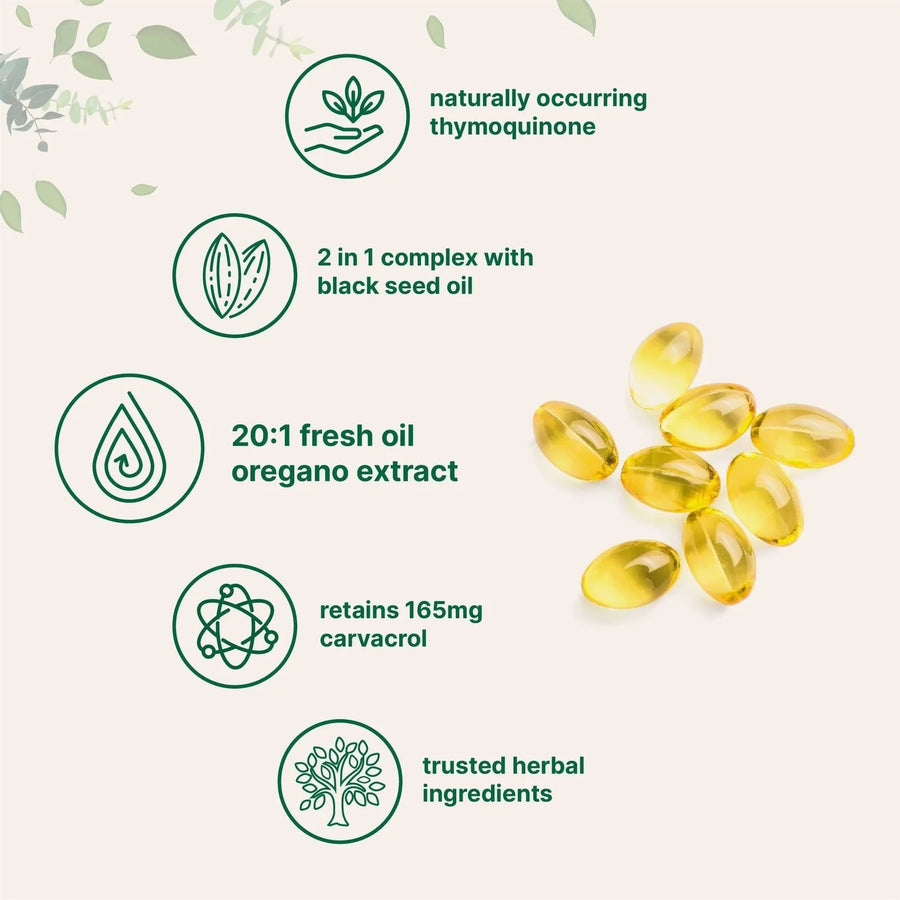
Oil of Oregano Softgels
High-carvacrol wild oregano in softgel form. Intestinal delivery, no aftertaste.
See the ProductForms Available and How They Compare
Oil of oregano supplements are available in three main formats: liquid drops, vegetarian hard capsules, and softgels. Each has distinct characteristics that affect tolerability, dosing precision, and delivery location.
Liquid drops are the most traditional format. They provide fast absorption and flexibility in dosing, but require contact between the concentrated phenolic oil and the mouth, throat, and stomach. This produces the characteristic burn and persistent aftertaste that makes sustained daily use difficult for many people. Dosing with a dropper is inherently imprecise.
Hard capsules contain powdered or granulated oregano extract rather than liquid oil. They are odorless and tasteless, but the bioavailability of oregano extract in dry form may be lower than in oil form due to the fat-soluble nature of carvacrol. Oil-based delivery is generally preferred for fat-soluble compounds.
Softgels contain the liquid oregano oil sealed in a gelatin or vegetarian capsule. They deliver the oil intact to the intestinal environment, bypassing stomach contact entirely. This eliminates burn, aftertaste, and stomach irritation while providing precise dosing and good bioavailability. For most people, softgels represent the optimal format for sustained daily use.
The history of oregano oil is not a story of rediscovery. It is a story of understanding. The ancients knew it worked. We now know why.
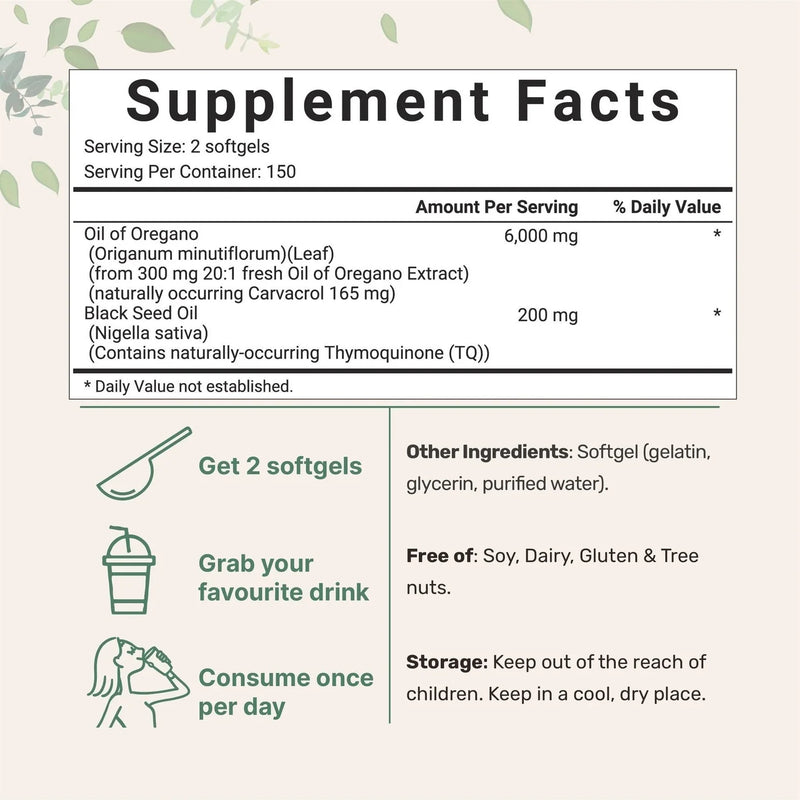
Oil of Oregano Softgels
Sealed softgel, intestinal release, wild-harvested carvacrol. No drops, no burn, no guesswork.
See the ProductBenefits: Where the Evidence Is Strongest
Antimicrobial activity is the most extensively documented benefit. Dozens of in vitro studies have demonstrated carvacrol's efficacy against gram-positive bacteria (Staphylococcus, Streptococcus), gram-negative bacteria (E. coli, Salmonella, Listeria), and fungi (Candida species). In vivo animal studies and some human observational studies support the translation of these effects to living systems.
Antifungal applications, particularly against Candida albicans, represent one of the most practically relevant uses. Candida overgrowth (candidiasis) affects a significant portion of the population in intestinal, vaginal, and oral forms. Carvacrol's ability to disrupt Candida cell membranes is well-documented in vitro, and multiple case series and small clinical studies suggest benefits in people managing recurrent candidiasis.
Gut health support follows from the antimicrobial mechanism: oregano oil's action on opportunistic intestinal bacteria and fungi can reduce bacterial and fungal overgrowth that drives symptoms like chronic bloating, irregular bowel function, and gas after eating. This is one of the most commonly reported benefits by people using oregano oil supplements.
Immune support is the broadest application and the most difficult to quantify in clinical terms. The antimicrobial properties of carvacrol are well-established; whether this translates to fewer or shorter common illnesses in supplementing humans is supported by user reports and some observational data, but definitive randomized controlled trial evidence in humans is still limited.
Oil of oregano is a well-characterized antimicrobial compound with documented mechanisms and reasonable evidence for several applications. It is not a cure for serious infections and should not replace prescribed medical treatment. It is most valuable as a preventive and supportive tool, particularly for immune maintenance, gut health, and managing mild or recurring fungal concerns.
Dosage, Cycling, and Contraindications
Standard dosage is 1 to 2 softgels per day taken with meals. Start with one per day for the first week to allow gut microbiome adjustment, then move to two per day if treating an active condition. For prevention and maintenance, one per day is typically sufficient.
Cycling is important: 4 to 6 weeks of daily use followed by a 2-week break. The same antimicrobial action that addresses pathogens also affects beneficial gut bacteria over extended continuous use. The break allows the microbiome to recover. A broad-spectrum probiotic taken during the off period supports this recovery.
Contraindications include pregnancy (carvacrol has uterotonic properties at higher concentrations), breastfeeding (insufficient safety data), and children under 12 (adult dosing is not appropriate for pediatric physiology). People on anticoagulant medications or blood thinners should consult their physician before starting, as oregano compounds may have mild anticoagulant effects.
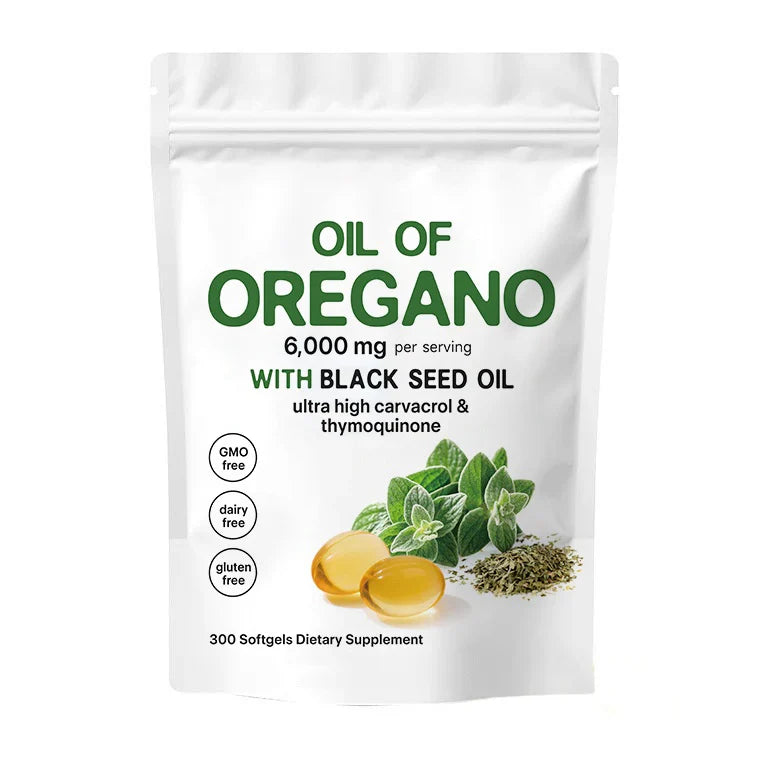
Oil of Oregano Softgels
Wild-harvested Origanum vulgare, high carvacrol, intestinal-release softgel. 1,900+ reviews.
See the Product