

Orthopedic Neck Pillow: The Key to Waking Up Pain-Free
Morning neck pain isn't just annoying. It's a direct signal that your cervical spine spent the night under stress it shouldn't have had to handle.
There's a difference between waking up tired and waking up in pain. Tired goes away with coffee. Pain that's already there before you've moved, before you've sat up, before the day has even started, that's structural. It means something happened during the night. And in the vast majority of cases, the thing that happened is that your neck spent six to eight hours in a position it was never meant to hold for that long.
Why Morning Pain Is Its Own Category
Pain that appears when you wake up is different from pain that builds over the course of a day. Daytime pain usually comes from movement, posture, or activity. Morning pain comes from sustained static load. Your cervical spine sat in a slightly wrong position for hours, and the tissues around it, the muscles, ligaments, joint capsules, and discs, responded with inflammation.
That inflammation doesn't build fast enough for you to feel it while you're sleeping. But by the time you've been lying still for several hours, it's accumulated. The first movement of the morning, rolling over, lifting your head, sitting up, is when you feel it all at once. That's why the pain feels worse at 7am than it will at noon. It's not that your body is stiff from being old. It's that you've been sitting in an inflammatory position all night.
The good news is that this type of pain is almost entirely mechanical. Fix the position, fix the problem. A properly designed orthopedic neck pillow addresses the position directly, which is why people who switch to one often notice changes within the first week.

Cervical Orthopedic Pillow by Lindalia
Dual-height contoured design holds your neck in a neutral position all night. Free shipping and satisfaction guarantee.
See the ProductSeven Hours of Accumulated Stress
Consider what seven hours of slightly-off positioning actually means for your cervical tissues. If your neck is just a few degrees out of neutral, the muscles on one side are in mild stretch while the muscles on the other side are slightly compressed. Neither position is painful at minute one. At minute sixty, still no acute pain. But over seven hours, the accumulated effect on muscle, tendon, and joint tissue becomes significant.
Muscles that stay in mild stretch for hours develop micro-tension. The fascia around them begins to tighten. The facet joints on one side of the neck experience sustained low-grade compression that irritates the synovial lining. The discs, which absorb fluid overnight as part of normal rehydration, do so in a position that may be subtly asymmetric, affecting how they load the vertebrae above and below.
None of this sounds dramatic. It isn't, on any given night. But repeat it three hundred and sixty-five times a year for several years, and you've created a pattern of tissue stress that starts to show up as chronic stiffness, reduced range of motion, and the kind of baseline soreness that makes people think they just "have neck problems."
If your neck pain is consistently worse on the side you sleep on, your pillow is almost certainly the cause. The compressed side experiences more joint irritation. Switching to a properly contoured pillow typically resolves this pattern within two to three weeks.
The Neck's Vulnerability at Night
During the day, your neck has several protective mechanisms working in its favor. You shift position constantly, even when sitting. The proprioceptive feedback system in your joints and muscles sends continuous signals to your brain about position, and your body makes micro-adjustments. Your muscles are warm, well-circulated, and responsive.
At night, those mechanisms are largely offline. You stay in the same position for stretches of thirty to ninety minutes between natural repositioning events. Muscle tone drops significantly during sleep, meaning the passive structures, the ligaments and joint capsules, take on more of the load. Blood flow to the muscles is reduced. Temperature drops slightly. The cervical spine has far less active protection than it does during waking hours.
This is precisely why pillow design matters so much at night specifically. Your body can tolerate a slightly wrong sitting position during the day because it's actively compensating. At night, there's no active compensation. Whatever position the pillow puts you in is the position you stay in, with minimal protective response, for hours at a time.
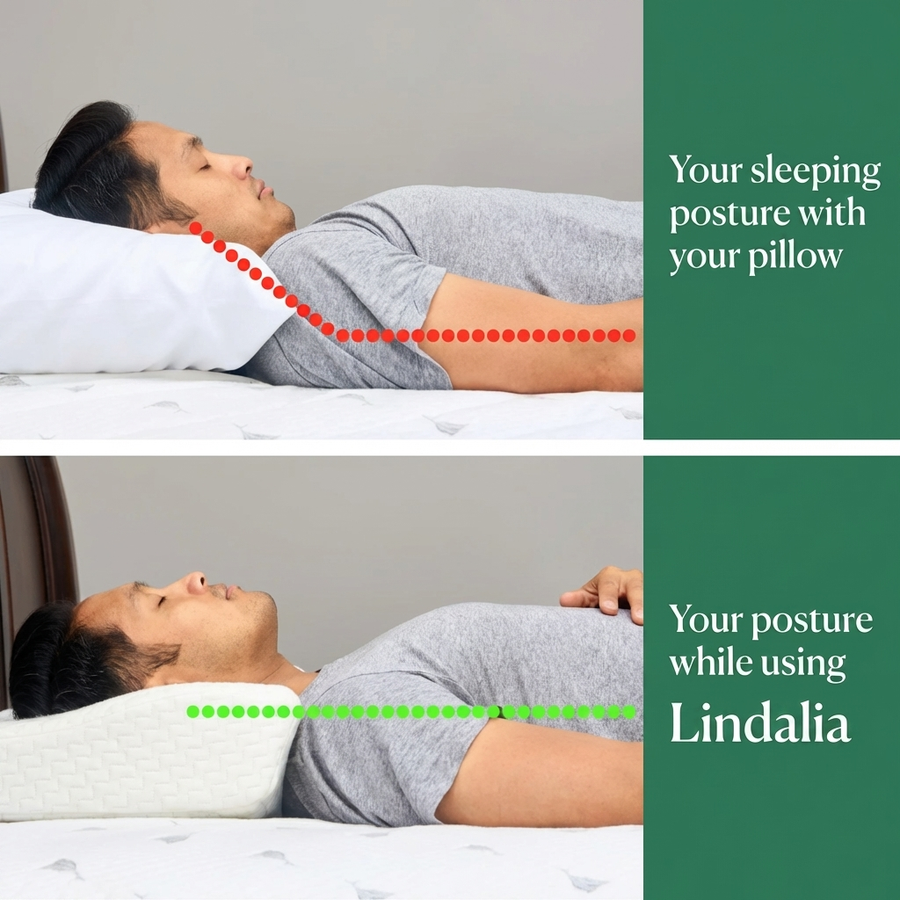
Support That Works While You Sleep
The cervical contour holds your neck in its natural position so your muscles can fully relax and recover overnight.
See the ProductWhat Genuine Cervical Support Actually Does
A well-designed orthopedic neck pillow does three things simultaneously. It fills the space between your head and your mattress to the exact height your anatomy requires. It supports the cervical curve without pushing it into either flexion or extension. And it distributes the weight of your head evenly so no single point takes excessive pressure over the course of the night.
The contour design is what makes the last two possible. A flat pillow can fill the head-to-mattress gap at the correct height, but it can't support the cervical curve separately from the head position. A contoured pillow has distinct zones: a lower central section that cradles the neck while letting the head sit at the right height for back sleepers, and raised side sections that bridge the ear-to-shoulder gap for side sleepers without tilting the head in either direction.
Memory foam is the material that makes this work mechanically. Unlike latex or fiberfill, which push back with the same force regardless of head position, memory foam responds to both pressure and warmth. It molds to the specific shape of your neck and head, meaning the support is custom rather than generic. Dynamic memory foam adds graduated density to that adaptive response, firmer where you need resistance, softer where you need cradling.
During REM sleep, which accounts for roughly 20 to 25 percent of a full night, your body is in a state of muscle atonia. Your cervical spine is at its most vulnerable during these periods. Pillow support is doing 100 percent of the postural work.
You wouldn't stand in a bad posture for seven hours. Why would you sleep in one?
Making the Transition: What to Expect
Switching to an orthopedic neck pillow after years of sleeping on a standard pillow can feel strange for the first few nights. Your muscles have adapted to your old sleeping position, including the compensatory tensions that came with it. When a properly supportive pillow removes those compensatory positions, the tissues need time to adjust to the new, correct alignment.
Some people experience mild soreness in unfamiliar muscle groups during the first three to five nights. This is not a sign that the pillow is wrong for them. It's the adaptation response of muscles that have been slightly shortened or lengthened for a long time beginning to normalize. Most people find the soreness resolves completely by the end of the first week, replaced by less stiffness and clearer mornings than they've had in years.
Give any new orthopedic pillow a minimum of two weeks before evaluating it. One night is not enough to know whether a pillow is working. Your tissues need time to decompress and adapt. Most people who push through the first week and assess at the two-week mark are genuinely surprised by how much their morning pain has decreased.
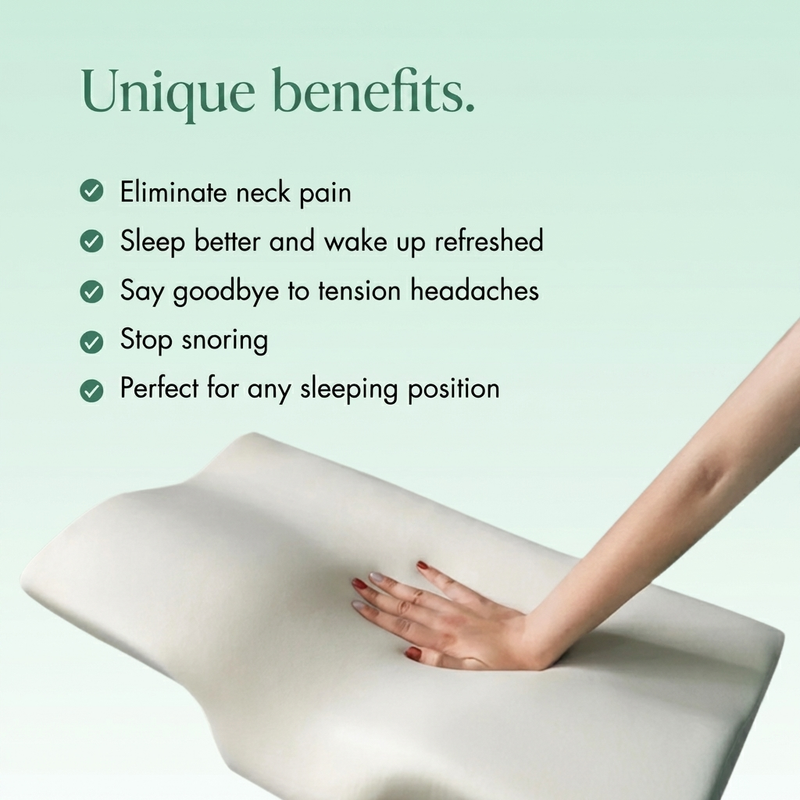
The Pillow That Fixes Your Mornings
Designed specifically for the neck, not just the head. Contoured memory foam that holds the right position all night long.
See the Product