

Orthopedic Neck Support Pillow: What Real Neck Support Looks Like
Support is one of the most misused words in the pillow industry. Here's what it actually means anatomically, and how to tell whether a pillow is providing it.
Walk through the bedding section of any store and you'll see "supportive" on almost every pillow label. Down pillows: supportive. Polyester fiberfill: supportive. Ultra-soft foam: supportive. The word has become meaningless through overuse, applied to products that compress flat under your head within minutes of lying down. Real cervical support has a specific anatomical definition. Here's what it actually means and how to recognize when a pillow is genuinely providing it.
Deconstructing the Word "Support"
In the context of the cervical spine, support means one thing: maintaining the natural inward curve (lordosis) of the cervical vertebrae in a position that requires no active muscular effort to hold. That's the complete definition. If your neck is in its natural curve and your muscles are relaxed, you have genuine cervical support. If your neck is in its natural curve but your muscles are working to maintain it, you have a pillow that's close but not there. If your muscles are working and your neck isn't even in its natural curve, you have no meaningful support at all.
Firmness is not the same as support. A firm pillow that holds your head too high is pushing your neck into flexion, which is not a supported position. A firm pillow that holds your head too low is letting your neck fall into extension, which is also not a supported position. A soft pillow at exactly the right height might provide better support than a firm pillow at the wrong height, because height accuracy matters more than material resistance in determining whether the cervical curve is maintained.
This is why the common advice to "get a firm pillow" for neck pain is oversimplified. Firmness without correct geometry doesn't produce support. The right combination is: a pillow with enough structural integrity to maintain its height and shape through the night, plus a contour shape that fills the specific anatomical gaps the cervical spine creates in different sleeping positions, plus a height that's calibrated to the sleeper's shoulder width and preferred position. All three together produce real support. Any two of three produces something less.

Orthopedic Neck Support Pillow
Height, contour, and foam density working together to maintain your cervical curve without requiring your muscles to do any of the work.
See the ProductA Mental Model of What's Happening in Your Neck
Picture your cervical spine from the side. Seven vertebrae stacked in a gentle inward curve, like the letter C laid on its side. The curve is deepest at C5-C6 (the mid-low cervical region) and shallower at the top and bottom. When you're lying on your back, gravity pulls the head down toward the mattress, and the cervical curve needs to be filled from below or the muscles must hold the curve up against gravity.
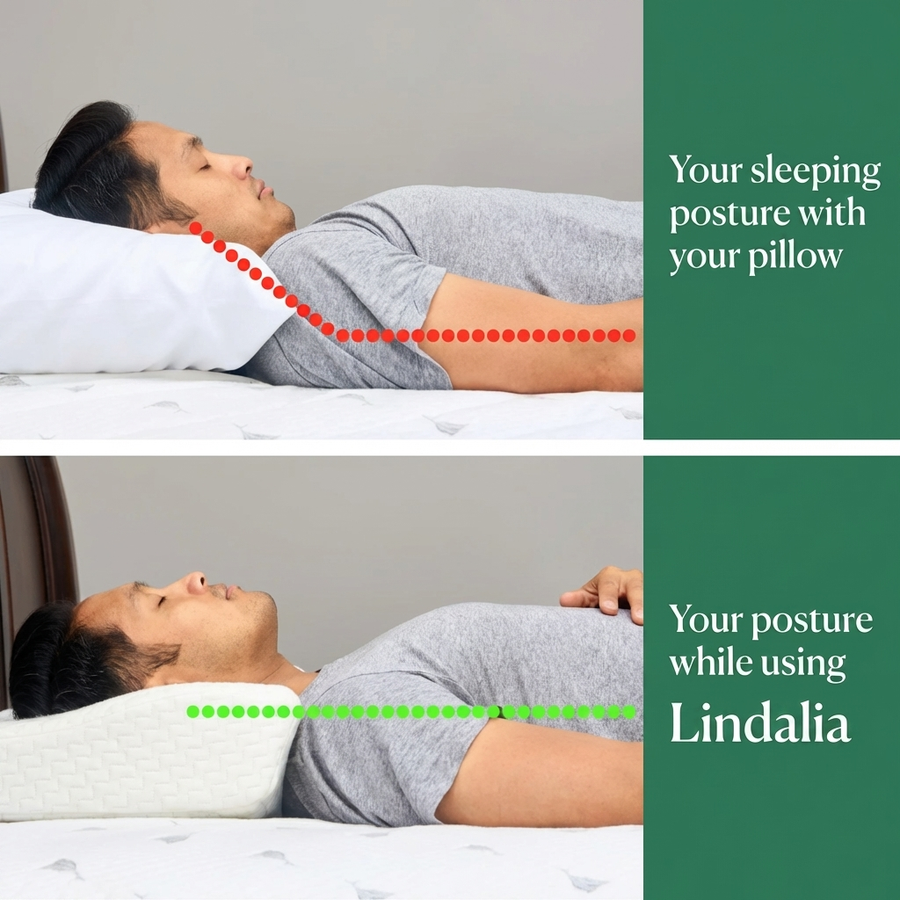
A flat pillow under the head raises the skull but doesn't fill the cervical curve below the skull. The muscles must activate to maintain that curve. After an hour, they fatigue. After two hours, they've been working continuously in a partial-contraction state they were never designed to sustain. The joint capsules around the facet joints are taking on load the muscles can no longer adequately share. By morning, the posterior cervical complex is inflamed, tight, and sending pain signals.
A properly contoured pillow fills the cervical curve from below. The raised foam on either side of the channel supports the underside of the neck, so the muscles don't need to hold the curve up against gravity. The head rests at the right height on the main body of the pillow, and the neck rests into the cervical channel below. Everything is passive. The muscles can go to zero activation. That's what real support enables: complete muscular rest during sleep.
Lie on a properly contoured pillow and consciously try to relax every muscle in your neck. If the pillow is providing genuine support, you should be able to fully let go. Your neck should feel held. If you can't relax fully without your head moving to an uncomfortable position, the pillow is requiring your muscles to compensate. That's not support.
How Pressure Points Reveal Inadequate Support
Pressure points are spots where the skin and underlying tissue experience concentrated load rather than distributed load. In the context of pillow support, pressure points on the occiput (the bony prominence at the base of the skull) or the temple indicate that the head's weight is being concentrated on a small area rather than spread across a larger one. This happens when the foam is either too firm (it doesn't conform) or too low-density (it compresses unevenly).
In side sleeping, pressure points on the ear or cheekbone indicate the same problem: the foam isn't distributing the weight of the head broadly enough. A properly responsive foam surface should have enough give that the skull and facial bones don't feel hard contact points, while maintaining enough core resistance to keep the overall height and position correct. This is the balance that quality memory foam achieves that neither latex (pushes back too uniformly) nor fiberfill (compresses too completely) can match.
Waking up with a numb patch of scalp, an indented ear, or marks on your face from the pillow surface are all indicators that the foam isn't distributing pressure adequately. These symptoms are usually signs of foam that's too dense and too firm, not too soft, because the foam isn't conforming to the skull's curved surface. If you experience these, look for a pillow with a softer surface layer combined with a firmer core, which is exactly what dynamic or graduated-density foam provides.
Support That Works Across Every Inch
Dynamic foam adapts to the curved surfaces of your head and neck, distributing weight evenly while keeping the cervical curve in its natural position.
See the ProductThe Role of the Mattress in Cervical Support
Your pillow doesn't work in isolation. The support equation includes your mattress, because the mattress determines how much your shoulder sinks below the neck in side sleeping, and how much your body sags in back sleeping. A mattress that's too soft changes the geometry that your pillow is trying to compensate for, sometimes in ways that require a different pillow configuration entirely.
A soft mattress allows the shoulder to sink deeply in side sleeping, which reduces the effective shoulder-to-ear gap and means you need less pillow loft than a firm-mattress sleeper with the same anatomy. People who switch from a firm mattress to a soft one sometimes find their existing orthopedic pillow suddenly feels too high, because the shoulder is now sitting lower than it was. The correct response is to adjust the loft (if the pillow is adjustable) or choose a lower-loft pillow for the new mattress.
For back sleepers, mattress firmness affects lumbar position, which has secondary effects on cervical alignment. A mattress that lets the lower back sag increases lumbar lordosis, which can create compensatory flattening of the cervical curve. The cervical support provided by the pillow may be anatomically correct in isolation but insufficient to compensate for the lumbar effect. Addressing lumbar support (with the mattress or a lumbar roll) can improve cervical alignment outcomes even without changing the pillow.
Lie on your side in bed with your current pillow and take a photo from behind (ask someone to take it, or set a timer). Check whether your spine is straight from neck to tailbone or whether there's a visible curve at the neck. If your neck is visibly higher or lower than the rest of your spine, your pillow height is off relative to your mattress. This tells you more than any pillow review.
Real neck support means your muscles clock out completely. If any part of your neck is working while you sleep, the pillow isn't doing its job.
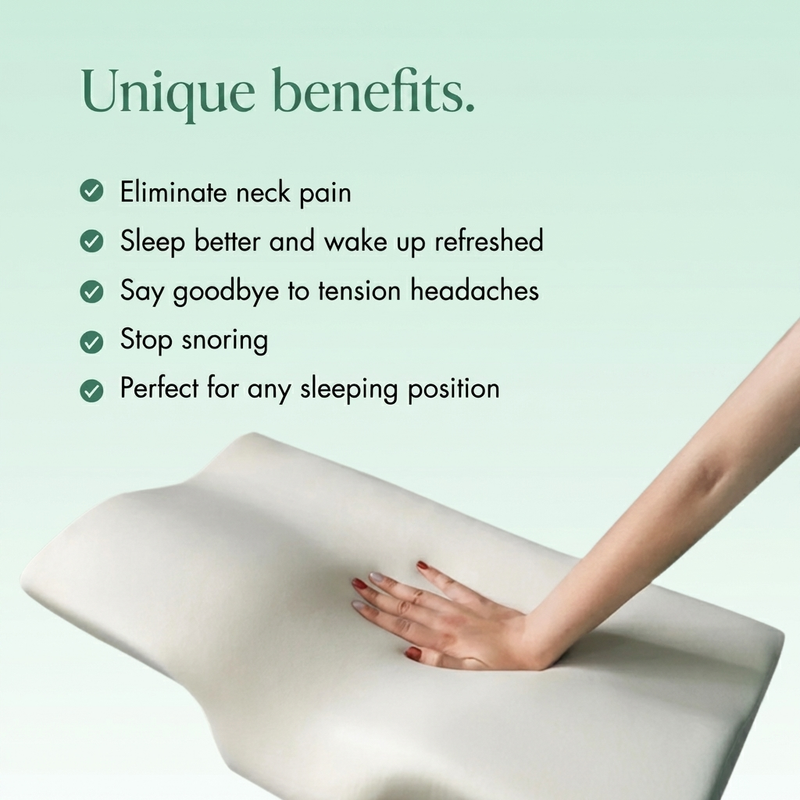
Cervical Orthopedic Pillow with Dual-Height Contour
Designed so your neck muscles can fully disengage during sleep. Dynamic foam, proper contour, free shipping, satisfaction guarantee.
See the Product