

Orthopedic Pillow for Side Sleepers: The Complete Guide
Side sleeping is the most popular sleep position, and the one where a wrong pillow causes the most damage. Here's what you need to get it right.
Side sleeping is the dominant sleep position for roughly 60 percent of adults. It has real advantages: it keeps the airway open better than back sleeping, reduces snoring, and is generally recommended during pregnancy. But it makes an unforgiving demand of your pillow that most pillows completely fail to meet: the gap between your ear and your shoulder must be bridged with millimeter-level precision. Too little, and your neck bends toward the mattress. Too much, and it bends the other way. Either direction produces the same outcome: hours of sustained lateral cervical flexion that shows up as pain, stiffness, and shoulder soreness by morning.
The Shoulder-Ear Gap: Why It's Specific to You
The gap between the outer edge of your shoulder and your ear, measured while lying on your side, varies significantly between people. Anatomical studies put the range at 9 to 16 centimeters across the adult population, with the average around 12 centimeters. A person with broad shoulders, a wide clavicle, or significant shoulder muscle mass will have a larger gap than someone with narrower shoulders. Body weight also affects it, because more body mass in the shoulder region changes the relative position of the shoulder to the head when lying on a mattress.
This variation is why "one size fits all" pillow heights don't work for side sleepers. A pillow height that keeps a narrow-shouldered 55-kilogram person's neck perfectly horizontal will leave a broad-shouldered 90-kilogram person's neck angled downward toward the mattress. Both people may be buying the same "orthopedic side sleeping pillow," but the experience and outcome are completely different based on their anatomy.
The practical implication is that choosing a pillow based on specifications requires knowing your own shoulder-to-ear measurement. Lie on your side on your usual mattress with no pillow. Place a book flat on the mattress next to your shoulder. The height of the book needed to keep your neck horizontal and your ear level with your shoulder is approximately your target loft. Most adults find this falls between 10 and 14 centimeters, but the only reliable measurement is your own.

Cervical Orthopedic Pillow with Raised Lateral Lobes
The higher side of the dual-height contour bridges the ear-to-shoulder gap precisely. Dynamic foam holds the height all night. Free shipping.
See the ProductWhy Most Pillows Fail Side Sleepers
Standard pillows fail side sleepers in three predictable ways. First, they're designed for back sleeping heights, which are significantly lower than side sleeping heights. A pillow that provides perfect back-sleeping support at 8 centimeters of loft is completely inadequate for a side sleeper who needs 12 centimeters. The neck simply bends toward the mattress, and the pillow provides the sensation of comfort without the structure of support.
Second, most pillows compress significantly under the sustained weight of the head. A pillow that starts at 12 centimeters of loft may be at 8 or 9 centimeters after two hours of sustained head weight. If 12 centimeters was the correct loft for that sleeper, they've spent most of their night with the neck in downward lateral flexion without realizing it. They woke up with a stiff neck and attributed it to "sleeping wrong," when what actually happened was their pillow compressing to an incorrect height during the night.
Third, most pillows don't maintain a consistent surface under the skull as it shifts position during sleep. Side sleepers move their head slightly throughout the night, rotating the neck forward and backward, shifting the position of the skull on the pillow surface. A pillow with poor shape retention creates areas of inconsistent support as the foam doesn't recover between these small movements, leaving the head in microscopically different supported positions across the night.
Before committing to a pillow, test it by lying on your side and placing two fingers between your ear and the pillow edge. If your fingers fit with room, the pillow is too low. If you can't fit even one finger, it may be too high. If one to two fingers fit snugly with the neck feeling level, you're in the right range.
The Cervical Spine Under Lateral Load
When the neck is in lateral flexion during sleep, meaning it's bent toward the mattress because the pillow is too low, the structures on either side of the cervical spine experience asymmetric loading. The muscles and discs on the concave side (the side the neck is bending toward) are compressed. The muscles and fascial structures on the convex side (the upper side) are placed in sustained mild stretch.
Both of these create problems, though they present differently. The compressed side develops joint irritation in the facet joints, disc compression at the affected levels, and muscle shortening that shows up as limited range of motion in the morning, specifically reduced side-bending and rotation toward the compressed side. The stretched side develops the characteristic upper neck and shoulder tension, as the trapezius and levator scapulae resist the sustained stretch by increasing their resting tone.
Over weeks and months of sleeping in this position, the pattern becomes entrenched. The compressed side develops chronic joint stiffness. The stretched side develops habitual muscular tension that doesn't fully resolve even after sleep on a better pillow, because the fascia has adapted to the shortened-lengthened asymmetry. This is why people who correct their pillow after years of sleeping on the wrong one often need several weeks or months of correct sleeping to fully resolve the asymmetric pattern.
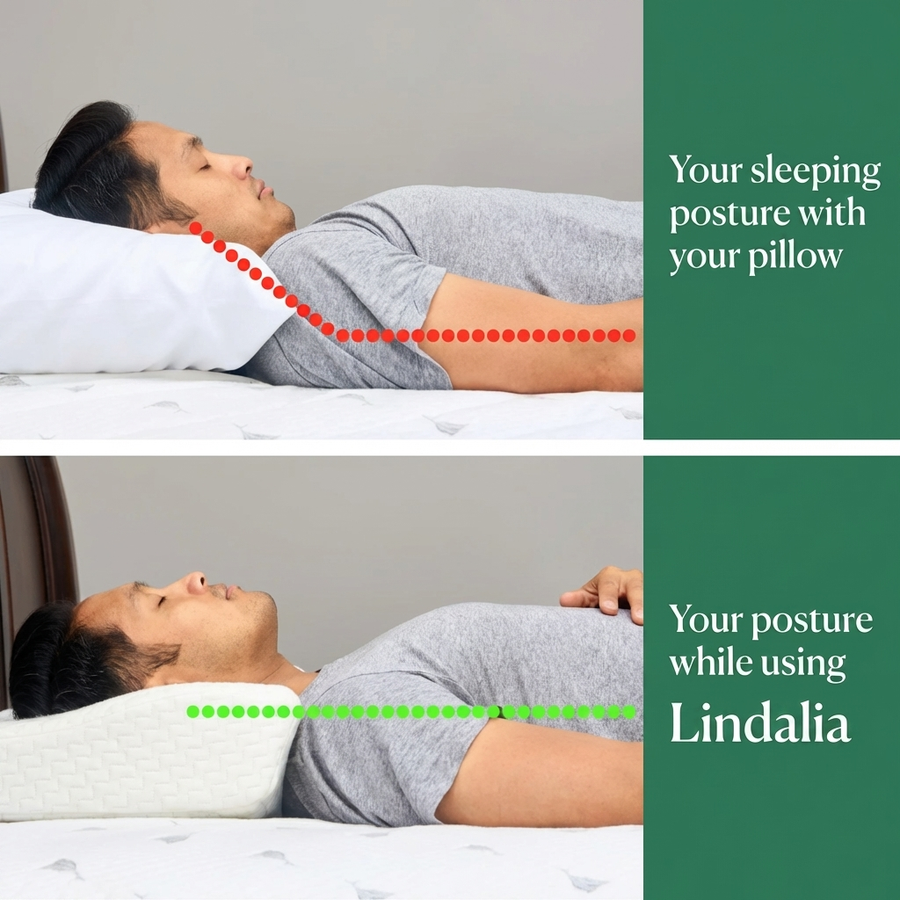
Support That Keeps Your Neck Horizontal
The elevated lateral lobes hold your neck in a perfectly horizontal position throughout the night, eliminating the asymmetric tissue loading that creates morning stiffness.
See the ProductMatching Pillow Type to Side Sleeping Needs
Not all contour pillows are equally suited to side sleeping. The key features to look for are: lateral lobe height that matches your shoulder-to-ear gap, foam density high enough to maintain that height under sustained head weight without compressing below the correct level, and a surface soft enough to cradle the skull without creating a hard pressure point against the ear or cheekbone.
The dual-height design is particularly valuable for side sleepers who also sleep part of the night on their back. The higher side addresses side sleeping needs, and the lower side addresses back sleeping needs. As you naturally roll between positions during the night, both positions are supported without requiring you to consciously adjust the pillow. For combination sleepers, this feature is essentially mandatory for consistent overnight cervical support.
Pillow width is also relevant for side sleepers specifically. A narrower pillow may not keep the head fully in the optimal zone as it moves forward and backward during sleep, particularly in the chin-tucked or chin-lifted positions that side sleepers often cycle through. A pillow with enough width to support the head across its natural range of lateral motion provides more consistent support than a narrow pillow that the head can move beyond during sleep.
If you experience shoulder pain while side sleeping, try placing a thin folded blanket or small pad under the shoulder that's against the mattress. This reduces the compression on the shoulder joint by lifting it slightly off the mattress surface. Combined with a correctly fitted cervical pillow, this two-point approach addresses both the cervical alignment and the shoulder compression components of side-sleeping shoulder pain.
Side sleeping is only hard on your neck when your pillow treats the gap between your shoulder and your ear as an afterthought.
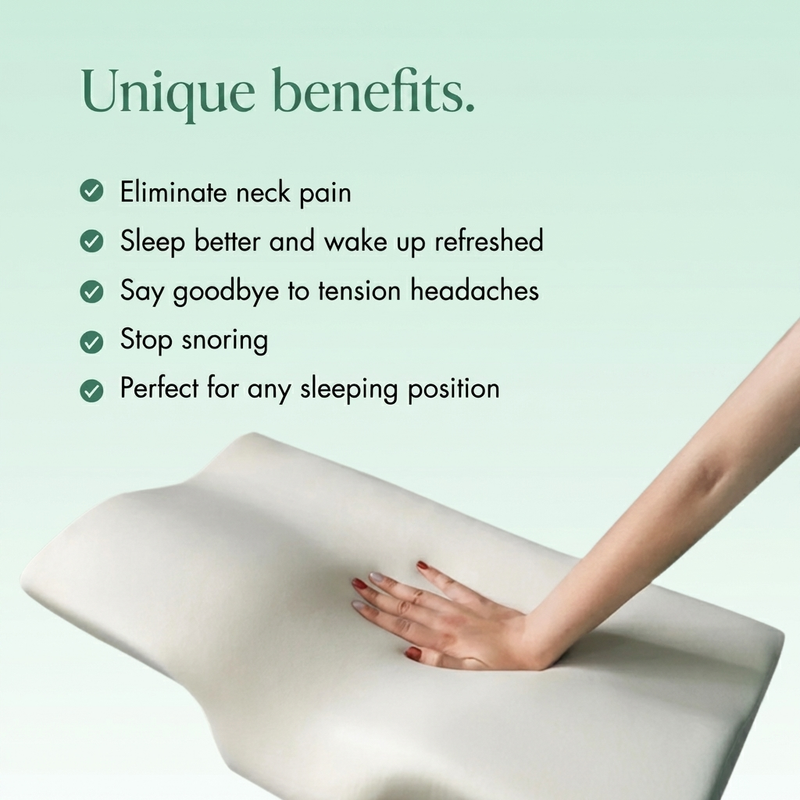
The Orthopedic Pillow Made for Your Shoulder Width
High-loft lateral lobes, dynamic foam, dual-height design. Bridges the gap, holds the height, keeps your neck where it should be.
See the Product