

How the Right Orthopedic Pillow Can Fix Your Sleep
Your mattress gets all the credit, but it's your pillow that's running the show every single night.
Neck pain when you wake up. Shoulders that feel locked. A headache before the day even starts. Most people blame a bad night's sleep on stress, their mattress, or just getting older. The actual culprit is almost always the thing their head has been resting on for seven or eight hours straight: their pillow.
The Real Relationship Between Your Pillow and Your Sleep Quality
Sleep researchers have spent decades studying what disrupts restorative sleep, and cervical misalignment consistently shows up near the top of the list. When your neck sits at an angle that isn't neutral, the muscles along your cervical spine stay partially contracted throughout the night. They can't fully relax because they're working to compensate for the positional stress your pillow is creating.
That constant low-level muscle tension does two things. First, it prevents you from spending enough time in deep, slow-wave sleep, the phase where your body does most of its physical repair work. Second, it means you wake up with muscles that have been working all night instead of recovering. The fatigue and stiffness you feel isn't from poor sleep alone. It's from eight hours of subtle, sustained strain.
A properly designed orthopedic pillow removes that strain by holding your cervical spine in a position that requires no muscular effort to maintain. When your neck is genuinely supported, the muscles around it can go completely slack. That's when real recovery happens.

Cervical Orthopedic Pillow
Designed to hold your neck in neutral alignment whether you sleep on your back or your side. Dynamic memory foam, dual-height contour, free shipping.
See the ProductWhat Happens Inside Your Neck While You Sleep
Your cervical spine has seven vertebrae, a natural inward curve, and an elaborate system of discs, ligaments, and muscles keeping it all together. During the day, gravity and movement help maintain that curve. At night, when you're horizontal and stationary, the only thing maintaining it is your sleeping surface.
Back sleepers need a pillow that fills the space between the back of their skull and the mattress without pushing the head forward. The cervical curve should be gently supported, not flattened or exaggerated. A pillow that's too thick tilts the chin toward the chest. Too thin, and the neck hangs in a position that strains the posterior muscles and compresses the facet joints.
Side sleepers face a different problem. There's a gap between the ear and the shoulder that needs to be bridged precisely. Too little loft and the neck bends toward the mattress, stretching the muscles on the upper side. Too much loft and the neck bends the other way, compressing the joints on the lower side. Getting that measurement right is what a proper orthopedic contour does.
Lie on your side and have someone look at your neck from behind. Your spine should form a straight line from the base of your skull to your tailbone. If your head dips down or lifts up, your pillow height is off.
The Domino Effect of Poor Cervical Alignment
The cervical spine is the top of a chain. When it's out of alignment, the rest of the chain compensates. The thoracic spine shifts. The shoulder girdle rotates. The jaw muscles tighten. People who sleep on poor pillows often develop tension in places that seem completely unrelated to their neck: the jaw, the temples, behind the eyes, between the shoulder blades.
Cervicogenic headaches are a classic example. They originate in the neck but present as head pain, often starting at the base of the skull and radiating forward. Many people treat them with painkillers for years without ever addressing the cervical source. Switching to a properly supportive pillow often reduces the frequency and intensity of these headaches within a few weeks.
The thoracic outlet is another area that suffers. When the neck is chronically misaligned during sleep, the muscles and soft tissue around the collarbone and first rib can tighten enough to compress nerves and blood vessels, creating tingling in the arms, numbness in the hands, or a general sense of heaviness in the upper extremities by morning.
Cervicogenic headaches account for roughly 15 to 20 percent of all chronic headaches seen in physiotherapy clinics. Many patients see significant improvement simply by correcting their sleeping position and pillow support.
Why Most Pillows Fail at the Basic Job
Standard pillows are designed for comfort, not support. They compress under the weight of your head within minutes, leaving your neck sitting directly on a thin layer of flattened fill. Feather and down pillows lose most of their loft in the first hour. Polyester fiberfill does the same. Even many basic memory foam pillows are cut from a single density of foam that feels supportive when you first lie down but offers no real adaptive resistance.
The problem with uniform-density foam is that it can't differentiate between the heavy part of your head and the lighter curve of your neck. It compresses evenly, which means neither the head nor the neck gets the specific support each requires. Your head sinks in slightly more than it should, your neck arch fills only partially, and the result is a position that's close to neutral but not quite there.
What orthopedic design addresses is that differentiation. A contoured pillow creates specific zones, higher loft at the sides for side sleepers, a lower central channel for back sleepers, and ideally a foam density that's graduated so softer material cradles the head while firmer material supports the neck.
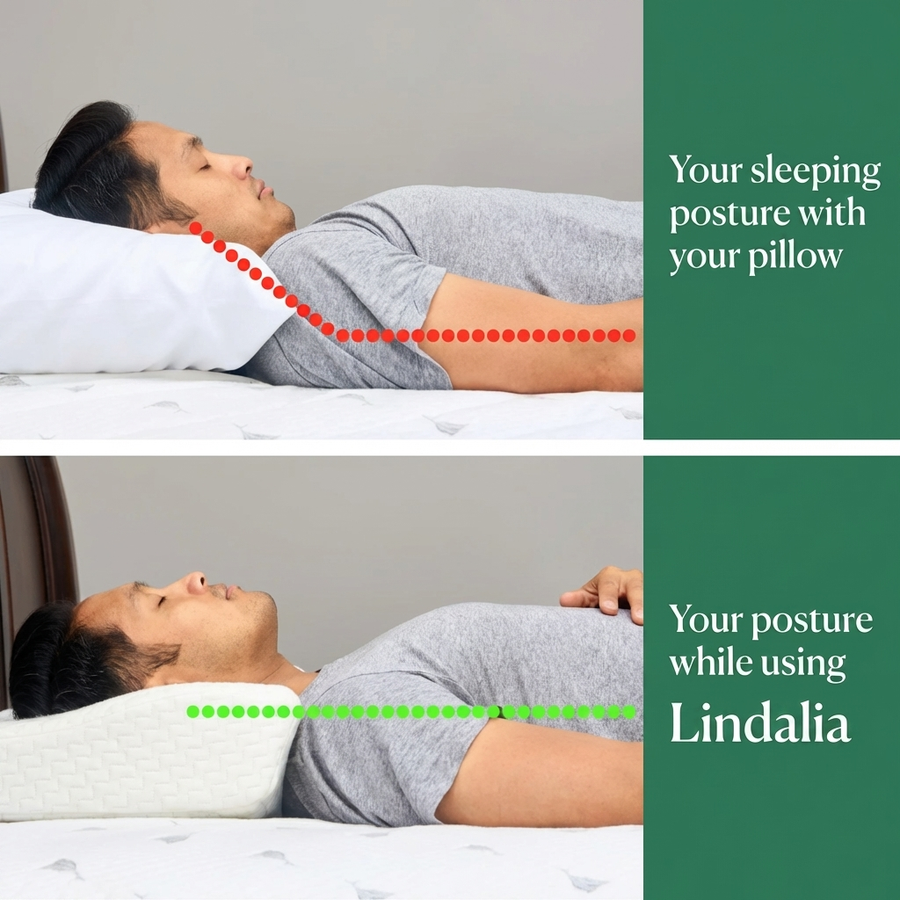
Stop Waking Up With a Stiff Neck
The Cervical Orthopedic Pillow uses dual-height contouring and dynamic memory foam to keep your spine aligned all night long.
See the ProductWhat to Actually Look for in an Orthopedic Pillow
Ignore marketing terms like "premium comfort" or "cloud-like feel." Focus on the technical specifications that determine whether a pillow will actually hold your neck in alignment. Contour shape is the first thing to assess: the pillow should have a clear cervical channel for back sleeping and raised lateral sections for side sleeping. That dual-height design is not a gimmick. It solves a real anatomical problem.
Foam density matters more than firmness alone. Density is measured in pounds per cubic foot. Low-density foam (under 3 lb/ft³) feels soft but compresses quickly and loses its shape. Medium-density foam (3 to 5 lb/ft³) balances support and pressure relief. High-density foam holds its shape but can feel rigid. Dynamic memory foam uses graduated density within the same piece of foam to adapt to different pressure levels across the pillow surface.
Height or loft is the third key variable, and it's directly tied to your body. Side sleepers with broad shoulders need more loft than those with narrow shoulders. Back sleepers need less. A pillow with multiple height options or adjustable fill gives you the flexibility to dial in the right position for your specific anatomy.
Seven hours of poor cervical alignment isn't something you can undo with a morning stretch. You have to fix the source.
How Long Before You Feel a Difference?
Most people notice changes within three to seven nights of switching to a properly supportive orthopedic pillow. The first few nights can actually feel slightly odd because your neck muscles aren't used to being in a truly neutral position for extended periods. They may have adapted to compensating for a bad pillow for months or years.
By the end of the first week, those muscles typically begin to let go of their habitual tension. Morning stiffness decreases. The baseline neck ache that seemed normal starts to lift. By the third or fourth week, people often realize how much low-grade discomfort they'd accepted as just how their body felt.
If you change your pillow and still have pain after two weeks, look at your mattress next. A mattress that's too soft can undermine even the best pillow by allowing the shoulders to sink too deeply and throwing off the entire spinal alignment chain. Pillow and mattress work together. Fix one, then assess whether the other also needs attention.
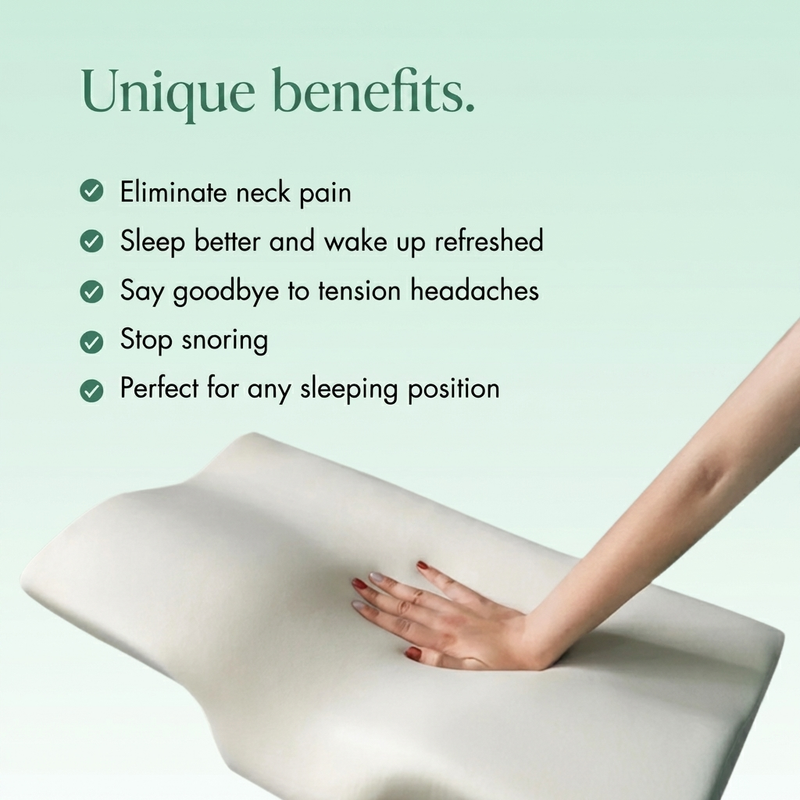
The Orthopedic Pillow Built for Real Relief
Contoured for back and side sleepers. Hypoallergenic dynamic foam. Satisfaction guarantee and free shipping.
See the Product